
Introduction
What is a hydrotreating unit? It is one of the most critical processing systems inside a modern oil refinery — a catalytic reactor-based unit that uses high-pressure hydrogen to strip away harmful impurities like sulfur, nitrogen, and metals from petroleum fractions before they reach your fuel tank or a downstream processing unit.
If you have ever filled up with ultra-low sulfur diesel, used aviation-grade jet fuel, or wondered how refineries meet tightening environmental regulations, the answer almost always involves a hydrotreating unit somewhere in the process chain. Despite being less famous than the flashy distillation towers you see on refinery skylines, hydrotreaters are arguably the backbone of modern clean fuel production.
This guide covers everything — the chemistry, the process steps, the key equipment, the different types of hydrotreating units, operating conditions, common problems, and how this technology is evolving to handle renewable feedstocks.
Hydrotreating Unit — Simplified Process Flow
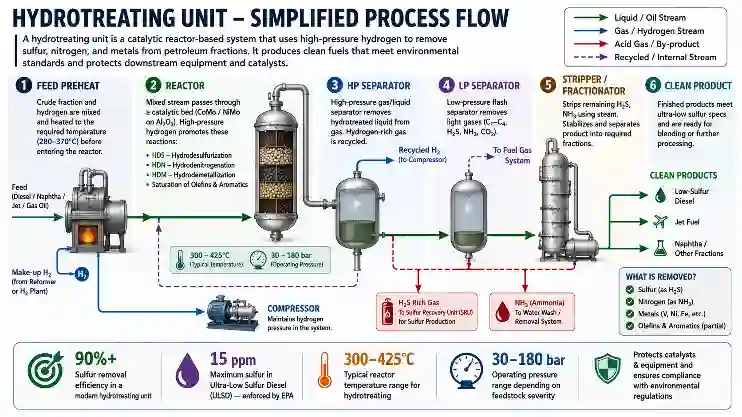
What Is a Hydrotreating Unit? The Simple Explanation
A hydrotreating unit — also called a hydrotreater, HDS unit (hydrodesulfurization unit), or simply HDT unit — is a refinery process unit that uses hydrogen gas and a solid catalyst to chemically remove impurities from petroleum-derived liquid streams. The impurities targeted include sulfur (the primary target), nitrogen, oxygen, and trace metals such as nickel, vanadium, and arsenic.
The basic concept is elegant: you take a contaminated petroleum stream — say, straight-run diesel from a crude distillation unit — pressurize it, mix it with hydrogen, heat it up, and pass it over a catalyst bed. The catalyst causes the sulfur and nitrogen atoms to react with the hydrogen, forming hydrogen sulfide (H₂S) and ammonia (NH₃), which are gases that can then be separated from the liquid product and removed.
What comes out the other end is a cleaner, more valuable hydrocarbon stream that meets fuel specifications, protects downstream catalysts from poisoning, and reduces the harmful emissions produced when the fuel is burned in an engine.
Hydrotreating vs. Hydrocracking — What Is the Difference?
People sometimes confuse hydrotreating with hydrocracking, but they serve different primary purposes. A hydrotreating unit is designed for purification — removing impurities while keeping the hydrocarbon molecules largely intact. Hydrocracking, by contrast, is designed for conversion — using higher pressures and more severe conditions to actually break apart larger hydrocarbon molecules into smaller, more valuable ones like gasoline and jet fuel.
Hydrotreating is almost always milder in its operating conditions and uses less hydrogen per barrel of feed than hydrocracking. Some process schemes combine the two — a hydrotreater upstream to protect the hydrocracker catalyst, followed by a hydrocracker for conversion.
The Chemistry Inside a Hydrotreating Unit — What Actually Happens
The chemistry of hydrotreating is based on a group of catalytic hydrogenation reactions. When the hydrogen-rich feed contacts the catalyst at elevated temperature and pressure, several reactions occur simultaneously. Each targets a different class of impurity.
| Reaction Type | Abbreviation | Impurity Removed | By-product Formed |
|---|---|---|---|
| Hydrodesulfurization | HDS | Sulfur (thiophenes, mercaptans, sulfides) | H₂S (hydrogen sulfide) |
| Hydrodenitrogenation | HDN | Nitrogen (pyridines, anilines, indoles) | NH₃ (ammonia) |
| Hydrodeoxygenation | HDO | Oxygen (phenols, naphthenic acids) | H₂O (water) |
| Hydrodemetallization | HDM | Metals (Ni, V, Fe, As) | Metal sulfides deposited on catalyst |
| Olefin Saturation | HYD | Unstable double bonds (olefins) | Saturated paraffins |
| Aromatic Saturation | HDA | Polycyclic aromatics | Cycloparaffins/naphthenes |
Of these, hydrodesulfurization is by far the most important from a regulatory and commercial standpoint. Sulfur-bearing compounds in petroleum vary widely in how easy they are to remove. Simple compounds like mercaptans (RSH) are relatively easy — they react with hydrogen at fairly mild conditions. Thiophenes are harder. The most stubborn are the substituted dibenzothiophenes (DBTs), which can require significantly elevated temperatures and pressures to remove. This is why producing ultra-low sulfur diesel is more challenging than producing low-sulfur diesel — you have to tackle those last, most resistant sulfur species.
The Role of the Catalyst in a Hydrotreating Unit
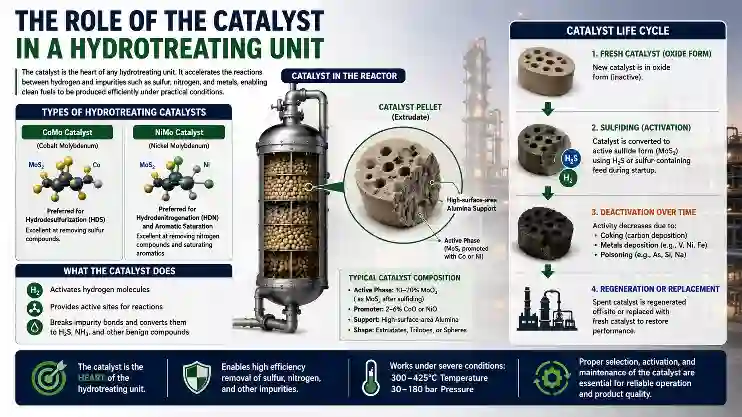
The catalyst is the heart of any hydrotreating unit. Without it, the reactions between hydrogen and the impurities would proceed far too slowly at practical temperatures. The most common hydrotreating catalysts are based on molybdenum disulfide (MoS₂) promoted with either cobalt (CoMo catalyst) or nickel (NiMo catalyst), supported on a high-surface-area alumina carrier.
CoMo catalysts are preferred for hydrodesulfurization — removing sulfur — while NiMo catalysts excel at hydrodenitrogenation and aromatic saturation. The choice of catalyst often depends on the feedstock and which impurity is the primary target.
Before use, hydrotreating catalysts must be “sulfided” — converted from their oxide form to their active sulfide form — either in a dedicated pre-sulfiding step or by contact with the sulfur-containing feed itself during initial startup. Over time, catalysts lose activity due to coking (carbon deposition on active sites) and metals deposition. When activity drops below acceptable levels, the catalyst must be regenerated or replaced.
Key Components of a Hydrotreating Unit — Equipment Breakdown
A hydrotreating unit is not just a reactor. It is an integrated system of pressure vessels, heat exchangers, separators, columns, and compressors that work together to process the feed, manage the hydrogen loop, and produce clean products. Here is a breakdown of the main equipment pieces:
Heats the combined feed-hydrogen mixture to reactor inlet temperature (typically 300–380°C). Usually a fired furnace with multiple passes. Controls the reaction rate by setting the temperature at which feed first contacts the catalyst.
Vertical pressure vessels containing one or more fixed catalyst beds. Feed flows downward (trickle-bed mode). Quench hydrogen is injected between beds to control exothermic temperature rise and prevent catalyst damage.
Separates the reactor effluent into a hydrogen-rich gas stream (recycled back to the reactor) and a liquid stream (sent for further processing). Operates at reactor pressure to preserve H₂ partial pressure.
Reduces pressure further to flash off remaining light gases and water. The liquid from the LPS goes to the stripper column for final cleanup of dissolved H₂S and NH₃.
Uses heat (reboiler steam or direct-fired) to strip H₂S, NH₃, and light hydrocarbons from the treated liquid. For units processing multiple cuts, a fractionator may separate the product into naphtha, kerosene, and diesel streams.
Recirculates hydrogen-rich gas from the high-pressure separator back to the reactor inlet, maintaining adequate H₂ partial pressure. One of the most critical and expensive pieces of rotating equipment in the unit.
Injects water into the reactor effluent to dissolve and remove ammonium bisulfide salts (NH₄HS) and ammonium chloride (NH₄Cl), which can cause severe corrosion and fouling in heat exchangers and separators.
Exchange heat between the hot reactor effluent and the cold feed, recovering energy that would otherwise be wasted in the charge heater. Critical for unit efficiency and operating economics.
Types of Hydrotreating Units in a Refinery
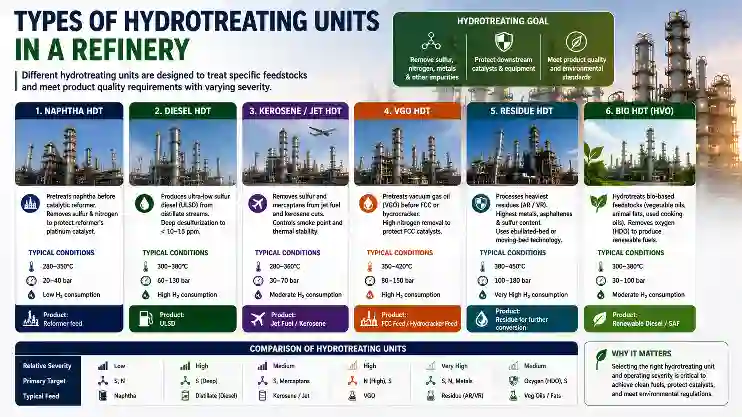
Not all hydrotreating units are the same. Refineries operate several different types depending on the feedstock being processed and the product specification that needs to be met. The severity of treatment — temperature, pressure, hydrogen consumption, and catalyst type — varies significantly between them.
Naphtha HDT
Diesel HDT
Kerosene / Jet HDT
VGO HDT
Residue HDT
Bio HDT (HVO)
Operating Conditions of a Hydrotreating Unit
The operating conditions inside a hydrotreating unit are not fixed — they depend heavily on the feedstock, the desired product specifications, and the state of the catalyst. Engineers and operators must balance several interacting variables to optimize performance.
Temperature
Reactor inlet temperature typically ranges from about 280°C for mild naphtha hydrotreating to above 400°C for deep desulfurization of heavy distillates or VGO. As the catalyst ages and loses activity, operators gradually increase the temperature to maintain conversion — a strategy called “chasing the catalyst.” The maximum allowable temperature is limited by catalyst stability, metallurgy of the reactor, and the risk of excessive cracking.
Pressure and Hydrogen Partial Pressure
Total reactor pressure in a hydrotreating unit typically falls in the range of 30 bar for naphtha units up to 150–180 bar for residue hydrotreaters. What actually matters most for the chemistry is the hydrogen partial pressure — the share of the total pressure that hydrogen represents. Higher hydrogen partial pressure suppresses coke formation, extends catalyst life, and drives more complete conversion of stubborn sulfur species.
LHSV — Liquid Hourly Space Velocity
Space velocity (LHSV) is the ratio of the liquid feed flow rate to the catalyst volume, expressed in volumes of feed per volume of catalyst per hour. A lower LHSV means more contact time between the feed and catalyst — more complete conversion but lower throughput. Operators adjust LHSV by changing the feed rate when the catalyst has aged and product specs are at risk of being missed.
Hydrogen-to-Oil Ratio
This is the volume of hydrogen circulated (both make-up and recycle) relative to the volume of feed processed. A higher ratio ensures adequate hydrogen supply to the catalyst surface, dilutes contaminants in the gas phase, and helps manage the exothermic temperature rise in the reactor beds.
Why a Hydrotreating Unit Is Critical in a Modern Refinery
It would be easy to view a hydrotreating unit as simply a regulatory compliance tool — something refineries build because the government tells them to. But the reality is more nuanced than that. Hydrotreaters create real, measurable economic and operational value across the refinery.
Meeting Environmental and Fuel Quality Regulations
Regulations like Euro VI in Europe, EPA Tier 3 in the United States, and equivalent standards across Asia have pushed sulfur limits in road fuels from several thousand ppm in the 1990s down to 10–15 ppm today. Without a capable hydrotreating unit, refiners simply cannot sell their product in regulated markets. The same trend is accelerating in aviation, where SAF mandates are driving demand for hydrotreated renewable feedstocks.
Protecting Downstream Catalysts
Downstream units like FCC, catalytic reformers, and isomerization units use expensive catalysts that are highly sensitive to sulfur, nitrogen, and metals poisoning. Even small amounts of these impurities — sometimes measured in parts per billion for platinum-based reformer catalysts — can permanently deactivate the catalyst. A well-operated hydrotreating unit is the guardian of the rest of the refinery’s catalyst inventory and directly impacts the economics of those units.
Improving Product Value
Beyond compliance, hydrotreating improves product quality in ways that command higher prices in the market. Treated naphtha has higher octane potential when reformed. Treated diesel has better cetane number, lower particulate emissions when burned, and better oxidative stability during storage. These quality improvements translate directly into refinery margin.
Common Challenges and Problems in Hydrotreating Unit Operations
Running a hydrotreating unit is not without its challenges. Even well-designed units face operational problems that require careful management.
Ammonium Bisulfide (NH₄HS) Corrosion
When H₂S and NH₃ are both present in the reactor effluent, they combine to form ammonium bisulfide, a highly corrosive compound. If the wash water injection rate is insufficient, NH₄HS deposits can cause rapid wall thinning in heat exchangers and separator vessels, leading to leaks and unplanned shutdowns. This is one of the most common and costly damage mechanisms in hydrotreating units.
Catalyst Deactivation and Bed Pressure Drop
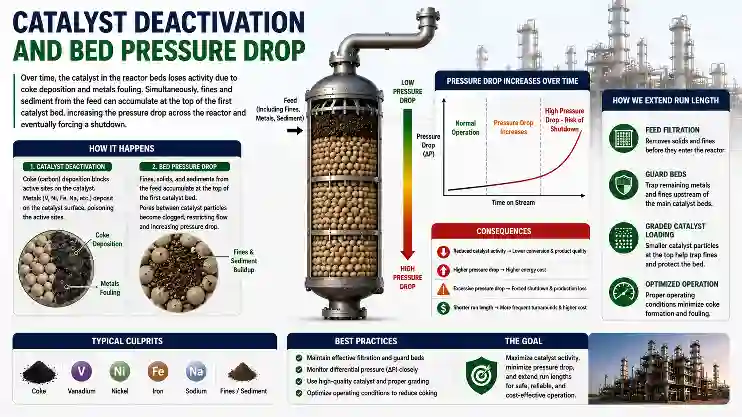
Over time, the catalyst in the reactor beds loses activity due to coke deposition and metals fouling. Simultaneously, fines and sediment from the feed can accumulate at the top of the first catalyst bed, increasing the pressure drop across the reactor and eventually forcing a shutdown. Feed filtration, guard beds, and graded catalyst loading at the bed top are used to extend run lengths.
Recycle Compressor Reliability
The recycle compressor is arguably the single most critical piece of equipment in a hydrotreating unit. If it trips or fails, the reactor loses hydrogen flow and the unit must shut down. Refineries invest heavily in compressor reliability, often using multiple seal systems, vibration monitoring, and dedicated spare compressor trains for critical units.
The Future of Hydrotreating — Renewables and Sustainable Aviation Fuel
The hydrotreating unit is not going anywhere. In fact, as the energy transition unfolds, these units are being repurposed and adapted in exciting ways.
The processing of bio-based feedstocks — vegetable oils, animal fats, tall oil, and used cooking oil — into hydrotreated vegetable oil (HVO) renewable diesel and sustainable aviation fuel (SAF) is one of the fastest-growing applications of hydrotreating technology. Many refineries are retrofitting existing units or adding new co-processing capability to handle these feeds alongside traditional petroleum streams.
The chemistry is different from conventional HDS — the primary reaction is hydrodeoxygenation, removing oxygen rather than sulfur — but the core equipment is similar. New catalyst formulations specifically designed for bio-based feeds are being commercialized by major catalyst suppliers, and process licensors are offering dedicated HVO/SAF process designs.
Additionally, research into next-generation catalysts — including bulk metal catalysts with higher activity and zeolite-based bi-functional catalysts — promises further improvements in selectivity and run length that will help refiners meet ever-stricter product specifications at lower operating cost.
Frequently Asked Questions About Hydrotreating Units
Q: What is the difference between a hydrotreating unit and a hydrotreater?
Q: How much hydrogen does a hydrotreating unit consume?
Q: What happens to the H₂S produced in a hydrotreating unit?
Q: Can a hydrotreating unit process renewable feedstocks?
Q: How long does a hydrotreating catalyst last?
Conclusion — Why Understanding the Hydrotreating Unit Matters
A hydrotreating unit might not be the most glamorous piece of equipment in an oil refinery, but it is one of the most indispensable. It sits at the crossroads of environmental compliance, product quality, and refinery economics — quietly doing the chemistry that makes clean, engine-ready fuel possible.
Whether you are a student of chemical engineering, a refinery operator, an environmental consultant, or simply someone curious about how cleaner fuels are made, understanding the hydrotreating process gives you insight into one of the most important — and often overlooked — chapters of modern industrial chemistry.
As regulations tighten and the energy landscape shifts toward renewables, the hydrotreating unit is evolving — not disappearing. The same chemistry that removes sulfur from crude-derived diesel is now producing sustainable aviation fuel from used cooking oil. That kind of adaptability is what keeps this technology at the center of refining, decade after decade.
About The Author
