
Introduction
What is a VDU unit? If you have spent any time in an oil refinery — or you are just starting to learn about how crude oil is processed — this is one of the first questions you will ask. The term comes up in refinery training, in shutdown planning meetings, and in inspection reports. Yet surprisingly, most explanations out there are either too technical or too vague to be useful.
This article changes that. Whether you are a fresh graduate joining a refinery for the first time, a QA/QC inspector brushing up on process knowledge, or simply someone curious about how oil refining works, you will find a clear, honest, and practical answer here.
We will cover what the VDU unit is, why every complex refinery needs one, how it works step by step, what products it makes, and what inspection challenges it presents. By the end, the VDU will make complete sense — no engineering degree required.
What is a VDU Unit? A Simple Answer Before We Go Deeper
If you work in a refinery — or you are just trying to understand how crude oil becomes useful products — you have probably heard the term VDU. But what is a VDU unit, exactly?
A VDU, or Vacuum Distillation Unit, is a processing unit in an oil refinery that takes the heavy leftovers from the first distillation step and separates them further — this time under very low pressure.
Think of it this way. When you boil water, it turns to steam at 100°C. But if you reduce the air pressure around the water, it boils at a lower temperature — maybe 60°C or even less. The VDU uses this same idea but for heavy oil. By lowering the pressure inside a big distillation column, the VDU gets heavy oil fractions to separate without burning or breaking apart.
That is the core idea. Everything else in this article builds on it.
Why Does a Refinery Need a VDU Unit?
To answer this, we first need to understand what happens before the VDU.
When crude oil enters a refinery, the first unit it goes to is the Crude Distillation Unit (CDU), also called the Atmospheric Distillation Unit (ADU). The CDU heats the crude oil and separates it into lighter products like naphtha, kerosene, and diesel.
But here is the problem. After the CDU takes out all the lighter stuff, a thick, dark, heavy oil remains at the bottom. This is called Atmospheric Residue (AR) or Long Residue.
This heavy material still has a lot of value locked inside it. It contains heavy gas oils that can be turned into diesel, jet fuel, and lubricants. But you cannot just heat it more inside the CDU. If you try, the heavy molecules will crack — they break apart into unwanted gases and black sludge. The valuable products are destroyed before they can be separated.
So the refinery sends this heavy oil to the VDU. Under vacuum conditions, the heavy fractions separate safely at much lower temperatures. No cracking. No waste. Just clean separation.
This is exactly why the VDU unit is so important in any modern oil refinery.
How Does the VDU Unit Work? — Step by Step
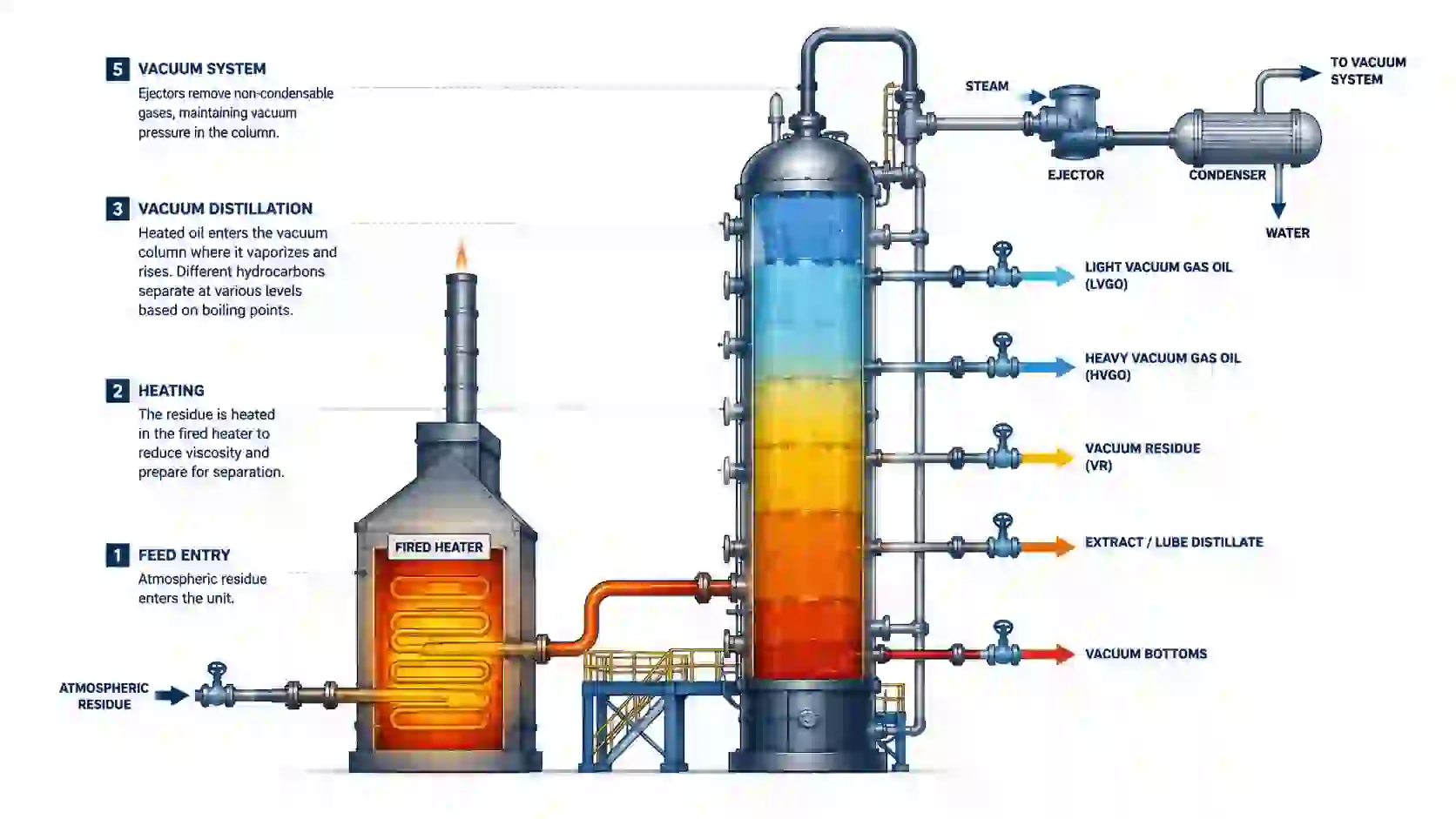
Understanding the VDU process is not hard if you take it one step at a time. Here is how it works from start to finish.
Step 1 — Feed Enters from the CDU Bottom
The atmospheric residue from the bottom of the CDU is pumped toward the VDU. Before it reaches the main column, it passes through a series of heat exchangers that warm it up using heat recovered from other parts of the refinery. This saves energy.
Step 2 — The Vacuum Furnace Heats the Feed
Next, the feed enters a large fired heater called the vacuum furnace. Here, the temperature is raised to around 360°C to 395°C. Steam is also injected into the furnace tubes. This lowers the partial pressure of the oil vapours inside the tubes and prevents the oil from sitting too long in the hot zone — which would cause coking (carbon buildup) inside the tubes.
For inspectors: tube condition inside the vacuum furnace is a major inspection concern during every shutdown. Coke deposits reduce heat transfer and can lead to tube failure.
Step 3 — The Vacuum Column Separates the Products
The hot feed enters the vacuum distillation column, which is the heart of the VDU unit. This column operates at a pressure of about 10 to 50 mmHg — far below normal atmospheric pressure of 760 mmHg.
Inside this column, the heavy oil vapours rise and separate based on their boiling points, just like in the CDU — but at much lower temperatures. Different products are drawn off at different heights of the column.
Step 4 — Products Are Collected and Cooled
Each product stream is drawn off, cooled in heat exchangers or air coolers, and sent to storage or to the next processing unit.
Step 5 — Vacuum is Maintained by the Ejector System
The low pressure inside the column is maintained by a steam ejector system or vacuum pumps. These continuously remove non-condensable gases and vapours from the top of the column. If the vacuum is lost, the whole separation process breaks down.
What Products Does the VDU Unit Make?
This is where things get really interesting. The VDU does not just process waste — it creates some of the most valuable feedstocks in the entire refinery.
Light Vacuum Gas Oil (LVGO)
- Boiling range: roughly 340°C to 400°C
- What it is: A lighter, cleaner gas oil fraction drawn from the upper part of the vacuum column
- Where it goes: Usually sent to the Fluid Catalytic Cracking (FCC) Unit or Hydrocracker to be converted into petrol and diesel
- Quality: Lower in metals like nickel and vanadium compared to HVGO — easier to process downstream
Heavy Vacuum Gas Oil (HVGO)
- Boiling range: roughly 400°C to 565°C
- What it is: A heavier gas oil fraction, rich in complex hydrocarbons
- Where it goes: The main feedstock for the FCC Unit and Hydrocracker in most refineries
- Quality note: Contains more metals than LVGO — metal content (nickel + vanadium) is closely monitored because high metals damage the FCC catalyst
Vacuum Residue (Short Residue)
- Boiling point: Above 565°C — it cannot be distilled further even under vacuum
- What it is: The heaviest bottom product of the VDU, dark and very thick
- Where it goes: Depending on the refinery setup, it is sent to the Delayed Coker Unit, Visbreaker, Solvent Deasphalting Unit (SDA), or used to make bitumen (asphalt for roads)
| Product | Boiling Range | Main Use |
| Light Vacuum Gas Oil (LVGO) | 340°C – 400°C | FCC / Hydrocracker feedstock |
| Heavy Vacuum Gas Oil (HVGO) | 400°C – 565°C | FCC / Hydrocracker feedstock |
| Vacuum Residue (VR) | Above 565°C | Coker / Visbreaker / Bitumen |
Key Equipment Inside a VDU Unit
To fully understand what is a VDU unit, you also need to know the main pieces of equipment inside it. Each one plays a specific role.
The Vacuum Furnace
This fired heater heats the feed before it enters the column. Steam injection inside the coil tubes is a design feature that prevents coking and reduces the required furnace outlet temperature.
Why it matters for inspectors: The furnace tubes operate under high temperature and thermal stress. Sulphidic corrosion, creep damage, and coke deposits are the main threats. Tube thickness surveys and internal inspections during shutdowns are essential.
The Vacuum Column
A large vertical vessel, often wider in diameter than the CDU column. The wide diameter is needed because gases at low pressure expand to much larger volumes than at atmospheric pressure.
Inside the column, structured packing or trays are used to improve the contact between vapour going up and liquid coming down. This contact is what makes separation possible.
The Steam Ejector System
A set of steam-driven ejectors arranged in multiple stages, connected by condensers between each stage. The ejectors pull non-condensable gases out of the system and maintain the vacuum.
Common problems: Ejector nozzle erosion, loss of steam pressure, and condenser fouling can all reduce vacuum quality. Reduced vacuum = poor separation = product quality problems.
Heat Exchangers and Condensers
Used throughout the VDU to recover heat from outgoing product streams and use it to preheat incoming feed. This heat integration is critical for keeping energy costs low.
Side Strippers
Small auxiliary columns attached to the main vacuum column. They strip out lighter components from the side draw streams (LVGO and HVGO) using steam, helping to meet product flash point specifications.
VDU Unit in the Refinery — Where Does It Fit?
Here is a simplified picture of how the VDU fits into the overall refinery flow:
Crude Oil → CDU (Atmospheric Distillation) → Atmospheric Residue (AR)
AR → VDU (Vacuum Distillation) → LVGO + HVGO → FCC Unit / Hydrocracker
VDU Bottom (Vacuum Residue) → Coker / SDA / Visbreaker / Bitumen Plant
Without the VDU, the atmospheric residue would either be sold as cheap fuel oil or burned — wasting enormous value. With the VDU, the refinery converts that heavy residue into high-value products, increasing both profitability and crude oil utilisation.
This is why refineries that have a VDU are considered more complex — and they typically earn higher margins per barrel of crude processed.
Common Problems in a VDU Unit — What Inspectors Need to Know
If you work as an inspector or QA/QC professional in a refinery, these are the damage mechanisms and operational problems you will come across in the VDU.
Sulphidic Corrosion
Heavy crude often contains sulphur compounds. At temperatures above 260°C, these compounds attack steel surfaces aggressively. The vacuum furnace transfer lines and the lower part of the vacuum column are the most vulnerable areas.
Inspection approach: UT thickness surveys on furnace transfer lines, piping elbows, and column shells in high-temperature zones.
Naphthenic Acid Corrosion
Crude oils with a high Total Acid Number (TAN) — often called opportunity crudes or high-acid crudes — can cause rapid corrosion between 220°C and 400°C. This range covers most of the VDU operating temperatures. Elbows, tees, reducers, and any location with high fluid velocity are especially vulnerable.
Inspection approach: Targeted UT scans at velocity-sensitive locations. Material upgrades to 316L SS or alloy steel may be required in high-TAN crude service.
Coke Formation in Furnace Tubes
If the oil stays too long in the hot furnace tubes, it begins to crack and deposit carbon (coke) on the tube walls. This reduces heat transfer, increases fuel consumption, and eventually leads to tube hot spots and failure.
Inspection approach: Tube inspection during decoking operations. Infrared scanning during operation to detect hot spots.
Vacuum Loss
Loss of vacuum in the column leads to increased boiling points and poor product separation. The main causes are ejector nozzle wear, steam quality problems, and condenser fouling.
Inspection approach: Regular monitoring of ejector performance. Condenser bundle inspection during shutdowns.
VDU Unit vs CDU Unit — What is the Difference?

People often get confused between the CDU and VDU. Here is a simple comparison:
| CDU (Crude Distillation Unit) | VDU (Vacuum Distillation Unit) | |
| Feed | Raw crude oil | Atmospheric Residue from CDU |
| Operating Pressure | Atmospheric (~760 mmHg) | Vacuum (10–50 mmHg) |
| Operating Temperature | Up to ~370°C | Up to ~395°C |
| Main Products | Naphtha, Kerosene, Diesel, AR | LVGO, HVGO, Vacuum Residue |
| Purpose | First separation of crude oil | Further separation of heavy residue |
The CDU comes first. The VDU comes second. Together, they form the front-end distillation section of a refinery.
Conclusion
So, what is a VDU unit? In simple terms, it is the unit in a refinery that handles the heavy oil left behind after the first distillation step — and separates it into valuable products by using vacuum conditions.
Without the VDU, refineries would leave enormous value sitting in heavy residue. With the VDU, they unlock that value in the form of vacuum gas oils that feed the FCC and Hydrocracker, and vacuum residue that feeds cokers and bitumen plants.
For oil and gas inspectors, the VDU is one of the most important units to understand — because it runs at high temperatures, handles corrosive feeds, and contains equipment that demands careful monitoring and regular inspection.
Whether you are new to refining or already working in the field, understanding the VDU unit is a key part of understanding how a modern oil refinery works.
Frequently Asked Questions (FAQs)
-
What does VDU stand for in oil and gas?
VDU stands for Vacuum Distillation Unit. It is a processing unit inside an oil refinery that uses reduced pressure (vacuum) to separate heavy oil fractions into valuable products like vacuum gas oil (VGO) and vacuum residue.
-
What is the difference between a CDU and a VDU?
The CDU (Crude Distillation Unit) processes raw crude oil at atmospheric pressure. The VDU processes the heavy bottom product from the CDU at much lower pressure — under vacuum. The CDU comes first in the refinery; the VDU comes second and handles the heavier fraction that the CDU cannot separate further.
-
What pressure does a VDU unit operate at?
A VDU typically operates at 10 to 50 mmHg absolute pressure. Normal atmospheric pressure is 760 mmHg. This very low pressure allows heavy hydrocarbons to boil at lower temperatures without cracking.
-
What are the main products from a VDU unit?
The three main products from a VDU are:
- Light Vacuum Gas Oil (LVGO) — used as feedstock for the FCC or Hydrocracker
- Heavy Vacuum Gas Oil (HVGO) — the primary FCC and Hydrocracker feedstock
- Vacuum Residue — sent to the Delayed Coker, Visbreaker, or used for bitumen production
-
Why is vacuum used in the VDU instead of just applying more heat?
If you simply applied more heat to the heavy residue at atmospheric pressure, the heavy hydrocarbon molecules would crack — meaning they break down into unwanted gases and solid coke instead of separating into clean product fractions. Vacuum lowers the boiling points so separation happens safely at moderate temperatures.
-
What is the vacuum residue from the VDU used for?
Vacuum residue — also called short residue or VR — is the heaviest fraction and cannot be distilled even under vacuum. It is typically processed in a Delayed Coker Unit to make petroleum coke and lighter products, or in a Visbreaker to reduce its viscosity for fuel oil blending, or sent to a bitumen plant to produce road asphalt.
-
What are the main corrosion threats in a VDU unit?
The two most common corrosion threats in a VDU are:
- Sulphidic corrosion — caused by sulphur compounds in crude oil at temperatures above 260°C
- Naphthenic acid corrosion — caused by organic acids in high-TAN crude oils, active between 220°C and 400°C
Both are major concerns for inspectors working on VDU piping, furnace transfer lines, and column shells.
-
How is vacuum maintained inside the VDU column?
Vacuum is maintained by a steam ejector system — typically a set of two or three ejectors arranged in series, with inter-stage condensers between them. Some modern refineries use liquid ring vacuum pumps instead of or in combination with ejectors. Maintaining the vacuum is critical; if it is lost, the column cannot separate products properly.
Suggested Posts
Crude Distillation Unit (CDU): How Crude Oil is Separated
Epoxy Coating Failure: Causes, Defects, Blistering and Prevention
Coating Blistering: Causes, Prevention & Role of Chloride Contamination
Coating Inspection Standards (ASTM & ISO): Field Reference Guide for Inspectors
About The Author
