
A delayed coker is called “delayed” because the coke formation reactions are intentionally delayed until the heated residue reaches the coke drums downstream of the furnace. This prevents coke from forming inside the furnace tubes, which would rapidly plug and damage the heater.
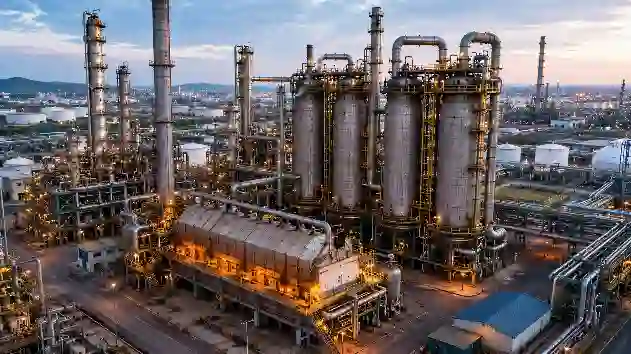
Put simply: Delayed coking heats heavy refinery residue in a furnace to around 480–505°C and then sends it to coke drums where cracking reactions complete over several hours. This produces valuable distillates (naphtha, gas oils) while the remaining carbon forms solid petroleum coke. The “delayed” name comes from shifting coke formation out of the furnace tubes into the drums.
What Is Delayed Coking? A Simple Answer Before We Go Deeper
Delayed coking, also known as the delayed coker unit (DCU) process, is one of the most important bottom-of-the-barrel upgrading technologies in modern refineries. It thermally cracks heavy, high-boiling residual oils that would otherwise become low-value fuel oil or asphalt.
In practice, the process turns problematic vacuum residue into transportation fuels and a solid byproduct called petroleum coke. Unlike continuous processes, delayed coking is semi-batch: feed flows continuously, but coke is removed from the drums in cycles.
A common misconception is that coke forms immediately in the furnace. In reality, operators carefully control temperature, velocity, and steam injection so that coking is delayed until the material reaches the drums.
Why Does Delayed Coking Matter in a Refinery?
Heavy crudes are increasingly common, producing more vacuum residue. Without conversion units like the delayed coker, refineries would be forced to sell large volumes of low-value heavy fuel oil, hurting margins.
Delayed coking maximizes distillate yields from residue, improves overall refinery economics, and provides flexibility when processing opportunity crudes. In my 15+ years working on refinery units, I’ve seen cokers act as the “garbage disposal” that keeps the rest of the plant running profitably.
Practical insight: A well-run delayed coker can significantly increase a refinery’s Nelson Complexity Index and its ability to handle sour, heavy feeds that many simpler refineries cannot process.
How Does a Delayed Coker Unit Work? — Step by Step
Here’s the process flow as it actually operates on site:
-
Feed Preparation Vacuum residue (sometimes mixed with recycle) enters the coker fractionator. It is preheated by exchanging heat with hot products.
-
Furnace Heating The bottoms stream is pumped through the coker heater (fired furnace). It is rapidly heated to 480–505°C (approximately 895–940°F) at low pressure (typically 10–30 psi). High-velocity steam is injected to suppress coke formation inside the tubes.
Inspection tip: Pay close attention to tube skin temperatures and pressure drop across the furnace passes — rising ΔP often signals early coke buildup.
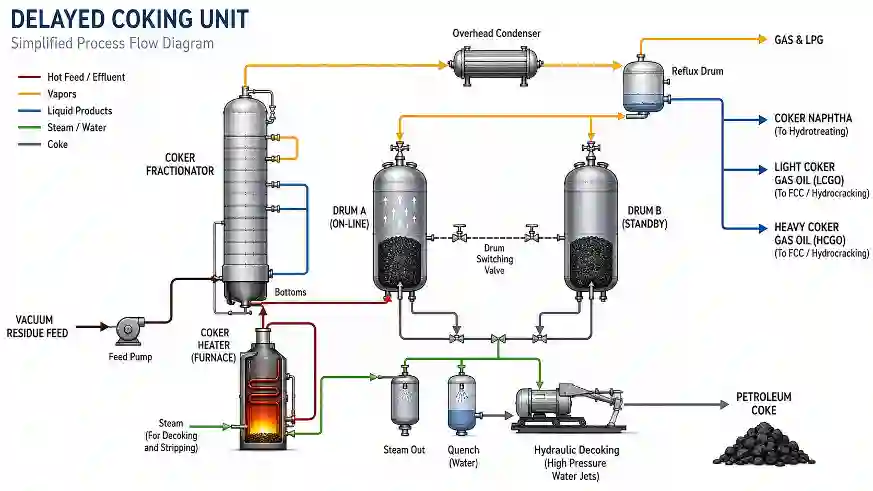
- Coking in Drums The hot effluent enters the bottom of an online coke drum. Residence time (typically 12–24 hours per drum cycle) allows thermal cracking and polymerization reactions to complete, forming lighter vapors and solid coke.
- Vapor Recovery Cracked vapors exit the top of the drum and return to the fractionator for separation into gases, naphtha, light coker gas oil (LCGO), and heavy coker gas oil (HCGO).
- Drum Switching and Decoking When one drum fills with coke, feed switches to the parallel drum. The full drum undergoes steam-out, quenching with water, draining, and hydraulic decoking using high-pressure water jets.
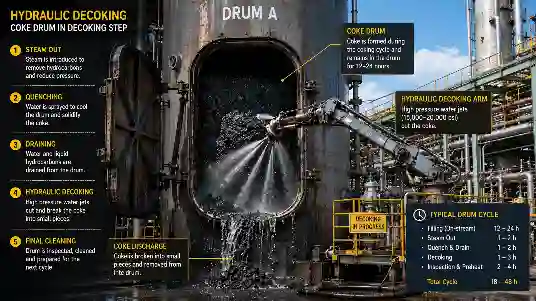
In practice, the cycle timing (usually 18–24 hours on-stream per drum) is critical for smooth operation. What inspectors commonly find is that poor cycle management leads to uneven coke deposition and increased mechanical stress on the drums.
Key Equipment Inside a Delayed Coker Unit
Coker Fired Heater Operates at high heat flux with multiple passes. Typical outlet temperature 480–505°C. Tubes are susceptible to carburization and creep. Regular inspection with IR thermography and UT thickness checks is essential.
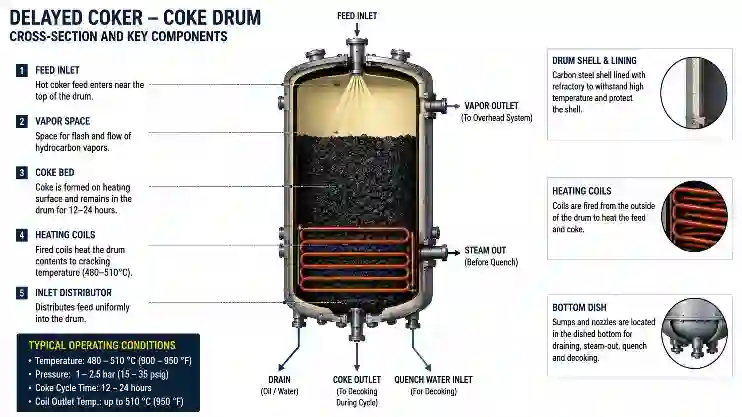
Coke Drums Large vertical vessels (often 4–10 m diameter, up to 30+ m tall). They cycle between high temperature and quenching, causing significant thermal fatigue. Modern drums often use chrome-moly or clad construction.
Coker Fractionator Separates the vapors into products. It sees heavy fouling potential from carryover.
Switch Valve / Transfer Lines Critical for safe drum switching. These see high thermal cycling and erosion.
What Products or Outputs Does Delayed Coking Produce?
Coker Gas and LPG Light ends rich in olefins, often sent to gas processing or alkylation.
Coker Naphtha Unstable, high in olefins and sulfur; requires further hydrotreating before gasoline blending.
Light and Heavy Coker Gas Oil (LCGO / HCGO) Main liquid products. These are excellent feedstocks for fluid catalytic cracking (FCC) or hydrocracking.
Petroleum Coke The solid carbon byproduct. Depending on feedstock and operation, it can be fuel-grade (high sulfur/metals) or anode-grade (low sulfur for aluminum production).
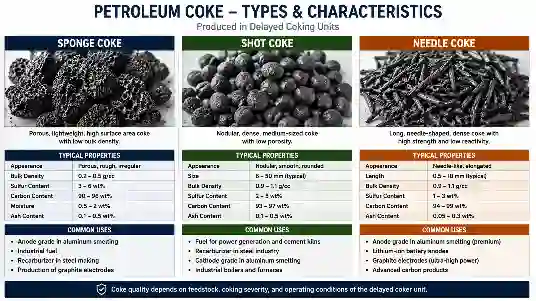
Typical Yield Summary (approximate, varies with feed CCR content):
| Product | Yield Range (wt% of feed) |
|---|---|
| Gases + LPG | 8–15% |
| Naphtha | 10–20% |
| Coker Gas Oils | 45–55% |
| Petroleum Coke | 20–35% |
Common Problems and Inspection Concerns
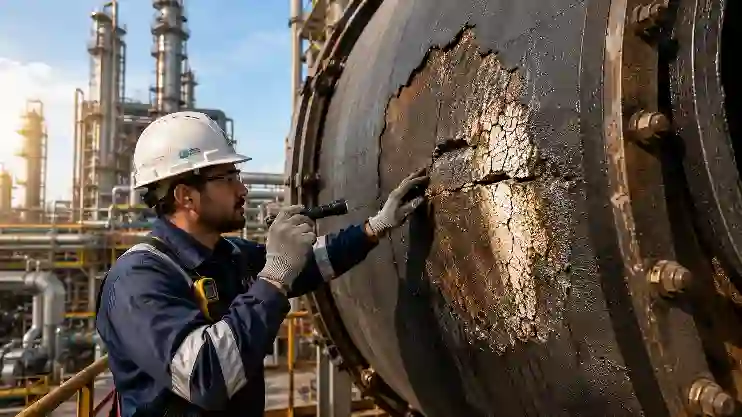
Coke Drum Cracking and Bulging Caused by repeated thermal cycling. Inspectors use acoustic emission testing and external UT during turnarounds. API 579 (Fitness-For-Service) is commonly applied.
Heater Tube Fouling and Coking Leads to hot spots and tube rupture risk. What inspectors commonly find is that improper steam injection or low velocity accelerates this.
Erosion-Corrosion in Transfer Lines High-velocity two-phase flow causes metal loss. API 571 damage mechanisms guide monitoring.
Common Misconception: Many people think delayed coking is a “dirty” or outdated process. In reality, with proper design and operation, modern cokers run reliably for decades and are essential for processing today’s heavy crudes.
Delayed Coking vs Fluid Coking — What Is the Difference?
Delayed coking is a semi-batch process with coke drums, while fluid coking is continuous using a fluidized bed of coke particles.
Comparison Table:
| Aspect | Delayed Coking | Fluid Coking |
|---|---|---|
| Process Type | Semi-batch | Continuous |
| Coke Removal | Hydraulic cutting from drums | Continuous circulation |
| Liquid Yield | Good | Slightly higher |
| Coke Type | Sponge/shot/needle | Finer powder |
| Capital Cost | Lower | Higher |
| Typical Application | Most refineries | Specific high-coke cases |
Conclusion
Delayed coking remains one of the workhorses of residue upgrading because it reliably converts low-value bottoms into valuable distillates and marketable coke. From a field perspective, success depends on careful attention to heater operation, drum cycle management, and proactive inspection of pressure equipment under cyclic service.
For any refinery processing heavier crudes, a well-maintained delayed coker unit is often the difference between strong margins and struggling economics.
Frequently Asked Questions
Why is it called delayed coking? The name comes from the deliberate delay of coke formation. Reactions are started in the furnace but allowed to complete in the coke drums, preventing tube fouling.
What is petroleum coke and how is it used? Petroleum coke is the solid carbon residue. Fuel-grade coke is burned for power, while anode-grade is used in aluminum smelting.
What is the temperature in a delayed coker? Furnace outlet is typically 480–505°C; coke drum temperatures range from 415–450°C during filling.
How long does a coke drum cycle take? A full cycle (filling + decoking + preheating) usually takes 18–48 hours depending on unit design and feedstock.
Is delayed coking safe? Yes, when proper procedures, instrumentation, and mechanical integrity programs (API 510, API 653) are followed. Thermal fatigue management is the biggest long-term concern.
What feedstock is used in delayed coking? Primarily vacuum residue from the vacuum distillation unit, sometimes blended with other heavy streams.
Can delayed coking handle high-sulfur feed? Yes. Sulfur concentrates in the coke and gas oil, which are then treated downstream.
How does delayed coking compare to hydrocracking for residue? Delayed coking has lower capital and operating costs but produces coke; hydrocracking gives higher liquid yields but at much higher pressure and hydrogen consumption.
Suggested Posts
What Is an Amine Recovery Unit? Process, Working & ARU in Oil Refineries
What Is a Sulphur Recovery Unit (SRU) in a Refinery?
What Is Alkylation Used For? The Process in Petroleum Refining
DHT Unit in Refinery: What It Is, How It Works, and Why It Matters
About The Author
