
Introduction
The DHT unit in a refinery is one of the most important processing units in a modern oil refinery. It cleans diesel fuel by removing harmful sulfur and other impurities using hydrogen. This guide explains everything — from the basic idea to the exact reactions, equipment, and conditions — in plain, easy language.
What’s in This Guide
- What Is the DHT Unit in a Refinery?
- Why Is Hydrotreating Needed? The Sulfur Problem
- DHT Unit Process Flow — Step by Step
- Process Flow Diagram of a DHT Unit
- Key Chemical Reactions in the DHT Unit
- Catalyst Used in the DHT Unit
- Main Equipment in the DHT Unit
- DHT Unit Operating Conditions
- DHT Unit Feed and Product Specifications
- Common Problems and Troubleshooting in DHT Units
- Frequently Asked Questions
What Is the DHT Unit in a Refinery?
The DHT unit in a refinery — short for Diesel Hydrotreater or Diesel Hydrotreating Unit — is a process unit that uses hydrogen gas and a special catalyst to clean diesel fuel. The main job of this unit is to remove sulfur from the diesel fraction that comes from the crude distillation unit (CDU) or other upstream units.
Think of it this way: raw diesel that comes out of a distillation tower is like unfiltered tap water. It has dissolved impurities — mainly sulfur compounds, nitrogen compounds, and sometimes oxygen and metals. If you burn this dirty diesel in a vehicle engine, the sulfur reacts with oxygen in the air and forms sulfur dioxide (SO₂), a harmful gas that causes acid rain and serious lung damage.
The DHT unit is the refinery’s “cleaning machine.” It takes that dirty diesel and passes it through a reactor filled with catalyst, along with high-pressure hydrogen gas. The catalyst and hydrogen work together to pull the sulfur out and convert it into hydrogen sulfide (H₂S) gas, which is then sent to another unit — the Sulfur Recovery Unit (SRU) or Amine Unit — for treatment.
The final product is called Ultra-Low Sulfur Diesel (ULSD) — diesel with a sulfur content below 10 parts per million (ppm). This is the clean, road-grade diesel sold at petrol pumps and used in cars, trucks, and buses.
DHT = Diesel Hydrotreating Unit. It removes sulfur, nitrogen, and other impurities from diesel fuel using hydrogen and a catalyst. The output is clean, ultra-low sulfur diesel (ULSD) that meets national and international fuel standards.
Why Is Hydrotreating Needed? The Sulfur Problem
Crude oil is a natural mixture of thousands of different chemicals. Many of these chemicals contain sulfur atoms bonded to carbon. When crude oil is distilled and broken into fractions — petrol, kerosene, diesel, fuel oil — the sulfur comes along for the ride.
Depending on where crude oil comes from, its sulfur content can range from less than 0.1% (sweet crude, like from Nigeria) to over 3% (sour crude, like from the Middle East). Indian refineries typically process a blend of both types.
When high-sulfur diesel is burned in a vehicle, here is what happens:
- Sulfur compounds combust to form SO₂ and SO₃ gases.
- These gases mix with water vapour in the atmosphere and form sulfuric acid — the main cause of acid rain.
- SO₂ is directly harmful to human lungs and causes respiratory disease.
- High sulfur also poisons catalytic converters in vehicles, making emission control systems useless.
- Nitrogen compounds in diesel cause NOx emissions, contributing to smog and ground-level ozone.
Governments around the world have responded with strict fuel quality regulations. In India, the Bharat Stage VI (BS-VI) standard — equivalent to Euro 6 — requires diesel to contain no more than 10 ppm of sulfur. This was implemented nationwide in April 2020. To meet this standard, every Indian refinery must have a DHT unit (or similar hydrotreating capacity) operating efficiently.
| Fuel Standard | Country / Region | Max Sulfur in Diesel | Introduced |
|---|---|---|---|
| BS-IV | India | 50 ppm | 2017 |
| BS-VI | India (current) | 10 ppm | 2020 |
| Euro 6 | Europe | 10 ppm | 2009 |
| Tier 3 / ULSD | USA | 15 ppm | 2006 |
| China VI | China | 10 ppm | 2019 |
DHT Unit Process Flow — Step by Step
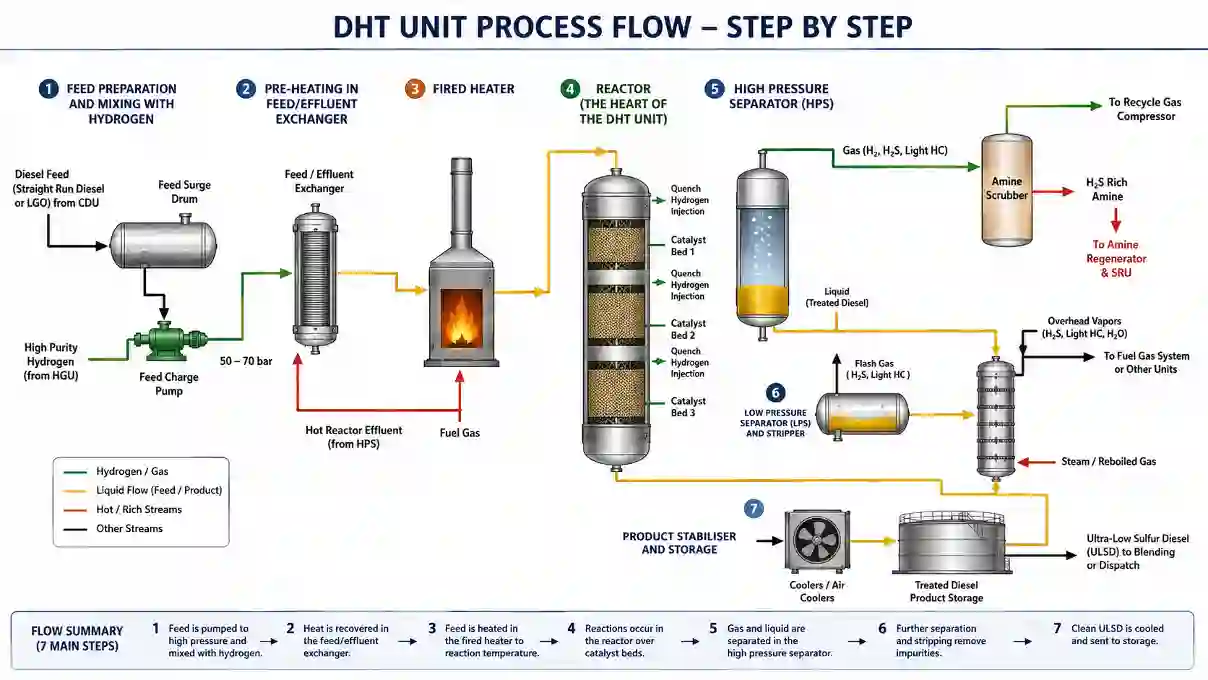
The DHT unit in a refinery follows a logical sequence of steps. Let’s walk through each one in simple language, as if you were watching the diesel flow from one piece of equipment to the next.
Step 1 — Feed Preparation and Mixing with Hydrogen
The diesel feed — called straight-run diesel (SRD) or light gas oil (LGO) — arrives from the crude distillation unit at a temperature of around 50–80°C and atmospheric pressure. It first goes into a feed surge drum, which acts like a buffer tank to ensure a steady, uninterrupted supply to the unit.
From there, the feed is pumped by the feed charge pump to high pressure — typically 50–70 bar. At this point, high-purity hydrogen (from the hydrogen generation unit or hydrogen recovery unit) is injected and mixed with the liquid diesel feed. This mixture of liquid diesel and hydrogen gas is then heated.
Step 2 — Pre-heating in the Feed/Effluent Exchanger
The cold feed-hydrogen mixture passes through a feed/effluent (F/E) heat exchanger. On the other side of this exchanger flows the hot reactor effluent (the output stream from the reactor). The two streams exchange heat — the cold feed gets warmer, and the hot effluent cools down. This is called heat integration, and it saves enormous amounts of fuel energy.
Step 3 — Fired Heater
After the F/E exchanger, the feed still isn’t hot enough for the reactions to happen quickly. It goes into a fired heater (a furnace), where the temperature is raised to the reactor inlet temperature — typically 300–380°C. The heater is fueled by refinery fuel gas.
Step 4 — Reactor (The Heart of the DHT Unit)
The hot feed-hydrogen mixture enters the hydrotreating reactor, which is a large, thick-walled steel vessel filled with catalyst. As the mixture flows downward through the catalyst beds, the reactions happen:
- Sulfur compounds react with hydrogen → H₂S gas is formed (this is desulfurization)
- Nitrogen compounds react with hydrogen → NH₃ gas is formed (denitrogenation)
- Olefins (unstable double-bond hydrocarbons) are saturated (hydrogenation)
- Oxygen compounds react → water is formed (hydrodeoxygenation)
These reactions are exothermic — they release heat. The temperature inside the reactor rises as the feed flows down. To control this, cold hydrogen (called quench hydrogen) is injected between catalyst beds to cool the mixture down to a safe temperature before entering the next bed.
Step 5 — High Pressure Separator (HPS)
The reactor effluent — now containing treated diesel mixed with H₂S, NH₃, light gases, and unreacted hydrogen — goes to the High Pressure Separator (HPS). Here, the gas phase (hydrogen, H₂S, light hydrocarbons) separates from the liquid phase (treated diesel) at high pressure.
The gas from the HPS, which is rich in hydrogen, goes to an amine scrubber to remove the H₂S. The cleaned hydrogen is then recycled back to the reactor by the recycle gas compressor — saving a large amount of expensive hydrogen.
Step 6 — Low Pressure Separator (LPS) and Stripper
The liquid from the HPS still contains dissolved gases and some H₂S. It moves to the Low Pressure Separator (LPS), where pressure is dropped and more gas flashes off. Then the liquid goes to the product stripper, a distillation-type column where steam or hot reboiled gas strips out the remaining H₂S, light gases, and water.
Step 7 — Product Stabiliser and Storage
The bottom product from the stripper is clean, treated diesel — now meeting the ultra-low sulfur specification. It is cooled in heat exchangers and air coolers, then sent to the product storage tanks. Small amounts of light ends (naphtha, LPG components) collected from the stripper overhead are sent to other units or used as fuel gas.
Key Chemical Reactions in the DHT Unit
The chemistry inside the DHT unit reactor can seem complex, but the core idea is simple: hydrogen breaks the bond between sulfur (or nitrogen) and the carbon chain, and the sulfur leaves as hydrogen sulfide (H₂S). These reactions are called hydrodesulfurization (HDS).
Hydrodesulfurization (HDS) — The Main DHT Reaction
The most common sulfur compounds in diesel are thiophenes, benzothiophenes, and dibenzothiophenes. Here is the simplified reaction:
R–S–R’ + 2 H₂ → R–H + R’–H + H₂S
Example (Thiophene):
C₄H₄S + 4 H₂ → C₄H₁₀ + H₂S
In plain English: the sulfur-containing molecule reacts with 4 hydrogen molecules. The carbon chain becomes a clean hydrocarbon (butane in this example), and the sulfur leaves as hydrogen sulfide gas (H₂S).
Hydrodenitrogenation (HDN)
R–NH₂ + H₂ → R–H + NH₃
The nitrogen leaves as ammonia (NH₃), which is scrubbed out downstream.
Hydrogenation of Olefins
R–CH=CH–R’ + H₂ → R–CH₂–CH₂–R’
Double bonds are converted to single bonds — making the diesel more stable and less reactive.
All these reactions are exothermic (they release heat). The reactor temperature increases as the reactions proceed. Operators must carefully monitor and control the temperature rise across each catalyst bed. A sudden uncontrolled temperature rise is called a temperature runaway and is the most serious safety concern in a DHT unit.
Catalyst Used in the DHT Unit in a Refinery
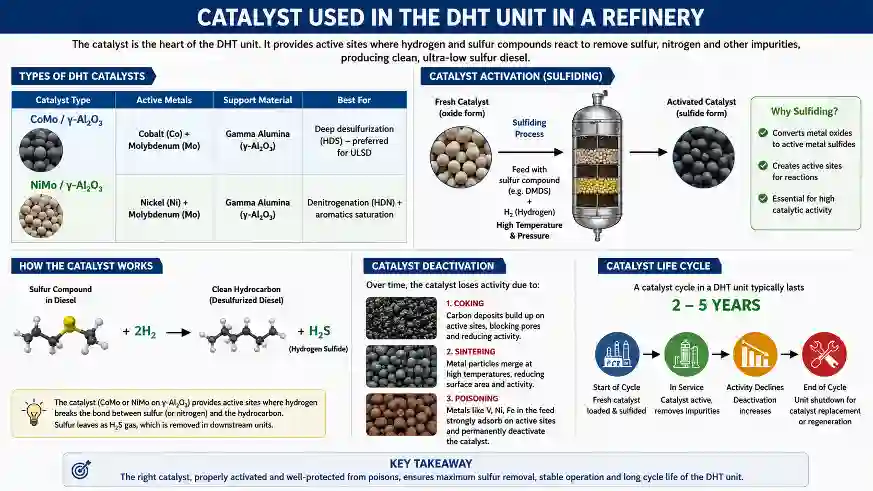
The catalyst is the heart of the DHT unit. Without it, the desulfurization reactions would be far too slow at practical operating temperatures. The catalyst provides active sites where hydrogen and sulfur compounds can meet and react efficiently.
Types of DHT Catalysts
The two most common catalyst types used in DHT units are:
| Catalyst Type | Active Metals | Support Material | Best For |
|---|---|---|---|
| CoMo / γ-Al₂O₃ | Cobalt (Co) + Molybdenum (Mo) | Gamma Alumina | Deep desulfurization (HDS) — preferred for ULSD |
| NiMo / γ-Al₂O₃ | Nickel (Ni) + Molybdenum (Mo) | Gamma Alumina | Denitrogenation (HDN) + aromatics saturation |
Catalyst Activation (Sulfiding)
A fresh DHT catalyst is loaded in its oxide form — it is not yet active. Before it can do its job, it must be converted to its sulfide form through a process called sulfiding (or presulfiding). This is done by passing a feed containing a controlled amount of sulfur (like DMDS — dimethyl disulfide) over the catalyst at elevated temperature and hydrogen pressure during startup.
Catalyst Deactivation
Over time, the catalyst loses activity due to:
- Coking — carbon deposits build up on active sites, blocking them
- Sintering — active metal particles merge at high temperatures, reducing surface area
- Poisoning — metals like vanadium, nickel, and iron in the feed permanently deactivate active sites
A catalyst cycle in a DHT unit typically lasts 2–5 years, after which the unit is shut down for catalyst replacement or regeneration.
Main Equipment in the DHT Unit
Let’s look at the key pieces of equipment in a typical DHT unit in a refinery and what each one does:
| Equipment | Function | Key Design Feature |
|---|---|---|
| Feed Surge Drum | Holds feed diesel, ensures steady supply, separates entrained water | Horizontal vessel with vortex breaker |
| Feed Charge Pump | Pumps diesel to high operating pressure (50–70 bar) | Centrifugal or reciprocating; motor-driven |
| Feed/Effluent Exchanger | Recovers heat from hot reactor effluent to pre-heat cold feed | Shell and tube; spiral wound for high-pressure service |
| Fired Heater / Furnace | Heats feed to reactor inlet temperature | Two-pass radiant coil; bridge wall temperature controlled |
| Hydrotreating Reactor | Houses catalyst beds where reactions occur | 2.25 Cr-1 Mo or 3.25 Cr steel; 2–4 catalyst beds with quench H₂ injection |
| High Pressure Separator (HPS) | Separates gas (H₂, H₂S) from liquid diesel at high pressure | Vertical vessel with mesh pad demister |
| Recycle Gas Compressor | Compresses recycled hydrogen back to reactor inlet pressure | Centrifugal or reciprocating; lube oil system critical |
| Amine Absorber (H₂S Scrubber) | Removes H₂S from recycle gas using amine solution | Trayed or packed column; lean amine in, rich amine out |
| Low Pressure Separator (LPS) | Further flashes gas from liquid at low pressure | Horizontal drum; level control critical |
| Product Stripper | Removes residual H₂S, light ends, and water from product diesel | Reboiled column; overhead condenser and reflux drum |
DHT Unit Operating Conditions
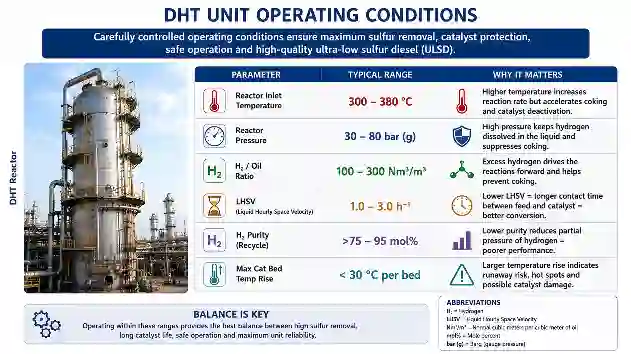
The operating conditions of the DHT unit in a refinery are carefully chosen to maximise sulfur removal while protecting the catalyst and equipment. Here are the typical ranges:
| Parameter | Typical Range | Why It Matters |
|---|---|---|
| Reactor Inlet Temperature | 300 – 380°C | Higher temp increases reaction rate but accelerates coking |
| Reactor Pressure | 30 – 80 bar (g) | High pressure keeps hydrogen dissolved and suppresses coking |
| H₂/Oil Ratio | 100 – 300 Nm³/m³ | Excess H₂ drives the reactions forward and prevents coking |
| LHSV (Liquid Hourly Space Velocity) | 1.0 – 3.0 h⁻¹ | Lower LHSV = longer contact time = better conversion |
| H₂ Purity (Recycle) | >75 – 95 mol% | Lower purity reduces partial pressure of H₂ = poorer performance |
| Max Cat Bed Temp Rise | < 30°C per bed | Larger rise indicates runaway risk or hot spots |
LHSV (Liquid Hourly Space Velocity) is the volume of liquid feed processed per hour divided by the volume of catalyst in the reactor. A LHSV of 1.5 h⁻¹ means that every hour, you feed a volume of diesel equal to 1.5 times the catalyst volume. Lower LHSV = more time for the reactions to happen = better sulfur removal.
DHT Unit Feed and Product Specifications
Typical DHT Unit Feed (Straight Run Diesel)
| Property | Typical Value |
|---|---|
| Sulfur Content | 0.5 – 2.5 wt% (5,000 – 25,000 ppm) |
| Nitrogen Content | 50 – 500 ppm |
| Density at 15°C | 820 – 870 kg/m³ |
| Boiling Range | 150 – 370°C |
| Colour | Pale yellow to amber |
Typical DHT Unit Product (Ultra-Low Sulfur Diesel)
| Property | Specification |
|---|---|
| Sulfur Content | < 10 ppm (BS-VI / Euro 6) |
| Nitrogen Content | < 5 ppm |
| Density at 15°C | 820 – 845 kg/m³ |
| Cetane Number | > 51 |
| Flash Point | > 55°C |
| Cloud Point | Per seasonal / regional spec |
| Colour | Clear to light yellow |
Common Problems and Troubleshooting in DHT Units
Even a well-designed DHT unit in a refinery can face operational challenges. Here are the most common problems and what operators typically do about them.
Problem 1 — High Product Sulfur (Off-Spec Diesel)
Causes: Catalyst deactivation, too-high LHSV (throughput too high), too-low reactor temperature, or low H₂ partial pressure.
Actions: Increase reactor inlet temperature (within safe limits), reduce feed rate, check recycle gas purity and compressor performance, check for H₂S breakthrough from amine scrubber.
Problem 2 — High Temperature Rise Across Catalyst Bed
Causes: Increased olefin or diolefin content in feed (common with cracked stocks), catalyst hot spots, channelling.
Actions: Increase quench hydrogen rate, check feed composition, reduce feed rate temporarily.
Problem 3 — Rapid Catalyst Deactivation (Shortened Cycle)
Causes: High metals content in feed (Ni, V, Fe), excessive nitrogen or organic chlorides, very high coking precursors from cracked feeds.
Actions: Install guard bed (demetallisation catalyst), review feed blend composition, operate at slightly lower temperature to slow coking rate.
Problem 4 — Recycle Gas Compressor Issues
Causes: Seal failures, vibration, liquid carryover from HPS into compressor suction.
Actions: The recycle gas compressor is a critical single-point-of-failure in most DHT units. Many refineries install a spare compressor (100% spare) to avoid unit shutdown. Regular vibration monitoring and seal gas maintenance are essential preventive measures.
H₂S (hydrogen sulfide) gas, formed in large quantities inside the DHT unit, is extremely toxic — it is immediately dangerous to life and health (IDLH) at just 100 ppm. All personnel working in or around the DHT unit must be trained in H₂S safety, carry personal gas detectors, and know the escape routes and muster points.
Frequently Asked Questions About the DHT Unit in a Refinery
▼
▼
▼
▼
▼
▼
Want to Learn More About Refinery Processes?
Explore our complete library of plain-English refinery guides — CDU, VDU, FCC, HCU, SRU, and more.
Related Articles
About The Author
