
Introduction
Paint viscosity plays a major role in coating quality, especially in refinery maintenance, offshore structures, storage tanks, and industrial steel painting. Even when the correct coating system is selected, poor viscosity control during application can lead to coating defects, low film thickness, overspray losses, sagging, or premature corrosion failure.
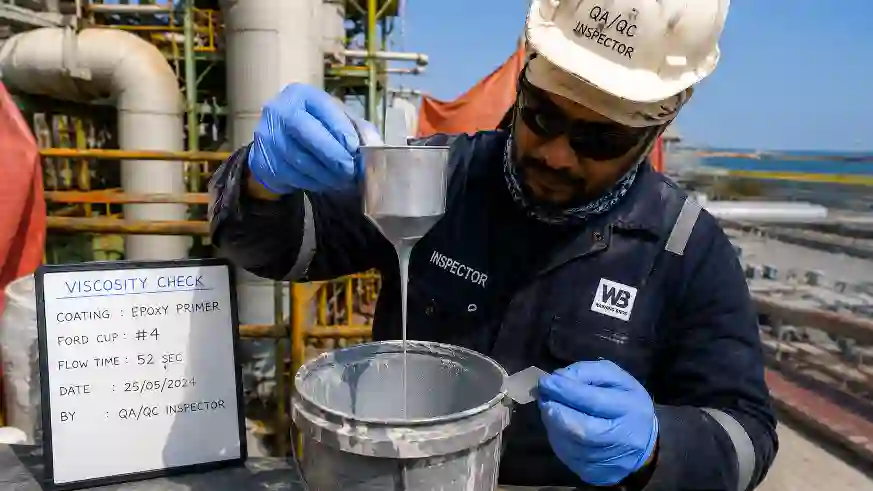
This is why paint viscosity testing is considered a basic but essential quality control activity in industrial coating inspection.
A paint viscosity cup helps inspectors verify whether a coating is suitable for spraying, brushing, or rolling under actual site conditions. The test measures how quickly the coating flows through a calibrated orifice, indicating whether the paint has been mixed and thinned correctly.
In practical field applications, proper viscosity control directly affects:
- Wet Film Thickness (WFT)
- Dry Film Thickness (DFT)
- Spray atomization
- Leveling and finish quality
- Edge retention
- Long-term coating performance
What Is a Paint Viscosity Cup?
A paint viscosity cup is a calibrated instrument used to measure the flow characteristics of paint, coatings, varnishes, and similar liquid materials.
The principle is simple:
- the cup is filled with coating material
- the coating flows through a small orifice
- the flow time is measured using a stopwatch
The longer the flow time, the higher the viscosity.
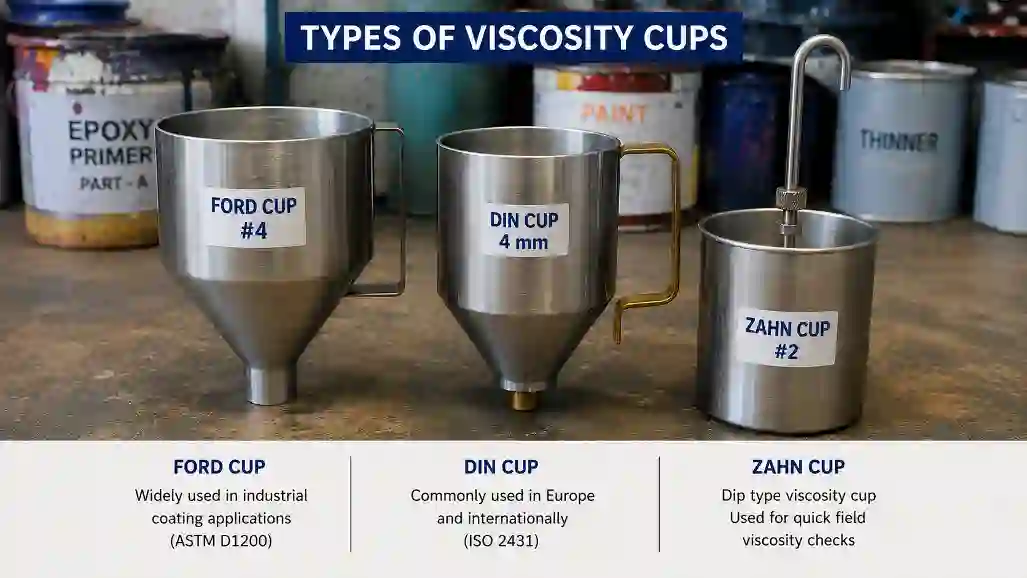
Common standardized cups include:
- Ford Cup
- DIN Cup
- Zahn Cup
Why Paint Viscosity Matters in Industrial Coating
Viscosity directly influences how a coating behaves during application.
High Viscosity Problems
Excessively high viscosity may cause:
- poor atomization
- orange peel texture
- uneven film build
- dry spray defects
Low Viscosity Problems
Excessively low viscosity may cause:
- sagging and runs
- low DFT
- reduced hiding power
- solvent entrapment
In refinery and offshore projects, uncontrolled thinning is one of the most common causes of coating inconsistency.
During hot-weather application, painters may add extra thinner to improve sprayability. While this improves application temporarily, it often leads to:
- low DFT readings
- overspray losses
- rework
- reduced corrosion resistance
Real Field Incident From Refinery Coating Work
During a refinery shutdown coating job on insulated carbon steel piping, inspectors observed repeated low DFT readings despite multiple spray passes.
Investigation revealed excessive thinner addition during high-temperature afternoon work when steel surfaces exceeded 45°C.
Ford Cup #4 readings confirmed viscosity below the manufacturer’s recommended range.
After correcting the mixing ratio and monitoring viscosity every two hours, coating consistency improved significantly.
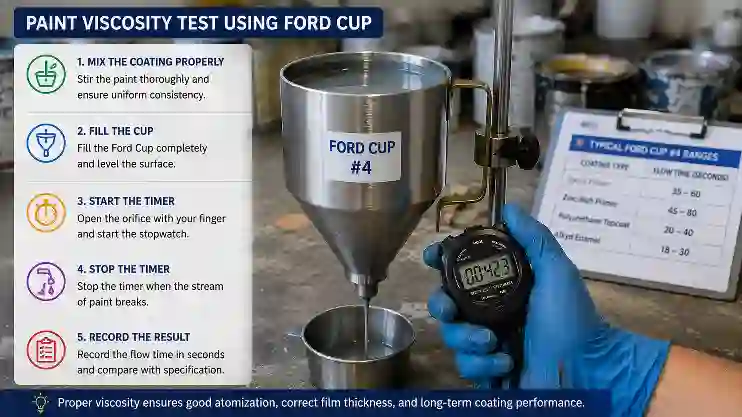
How a Paint Viscosity Cup Test Is Performed
Mix the Coating Properly
Proper mixing is essential, especially for:
- zinc-rich primers
- high-build epoxies
- glass flake coatings
- heavy-bodied materials
For multi-component coatings:
- base and hardener must be mixed correctly
- induction time must be respected
- thinner must follow the Product Data Sheet (PDS)
Clean the Viscosity Cup
The cup must be completely clean.
Even small residues inside the orifice can distort flow time and affect accuracy.
Fill the Cup
The cup is filled completely while avoiding air bubbles.
Most inspectors slightly overfill and level the surface using a straight edge.
Measure Flow Time
The orifice is opened while starting a stopwatch.
Timing stops when the continuous stream breaks.
Result is recorded in seconds.
Compare With Specification
Results are compared with:
- manufacturer recommendations
- Product Data Sheet (PDS)
- project specifications
- applicable standards
Typical Ford Cup #4 Ranges:
| Coating Type | Typical Range |
|---|---|
| Epoxy Primer | 35–60 sec |
| Zinc-Rich Primer | 45–80 sec |
| Polyurethane Topcoat | 20–40 sec |
| Alkyd Enamel | 18–30 sec |
Common Types of Paint Viscosity Cups
Ford Cup
Widely used in industrial coating inspection.
Applications:
- refinery maintenance
- structural steel
- tank coating
- offshore work
Standards:
- ASTM D1200
- ASTM D5125
DIN Cup
Used in European and EPC projects.
Standard:
Zahn Cup
Portable dip-type cup used for quick field checks.
Operator technique affects accuracy more than other cup types.
Effect of Paint Viscosity on WFT and DFT
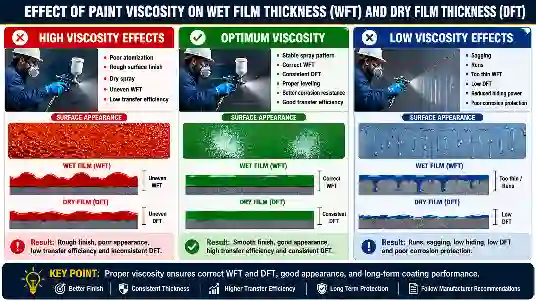
Viscosity directly affects film formation and thickness.
High Viscosity Effects
- poor atomization
- rough surface finish
- dry spray
- uneven WFT
Low Viscosity Effects
- sagging
- runs
- low DFT
- reduced hiding power
Optimum Viscosity
Ensures:
- stable spray pattern
- correct WFT
- consistent DFT
- proper leveling
- better corrosion resistance
Temperature–Viscosity Relationship
Paint viscosity changes with temperature.
| Condition | Effect |
|---|---|
| Low Temperature | Higher viscosity |
| High Temperature | Lower viscosity |
| Excessive Heat | Faster solvent evaporation |
| Cold Weather | Poor atomization |
Viscosity testing should always be aligned with manufacturer-recommended temperature ranges.
Inspector Tip
Experienced inspectors perform viscosity checks multiple times during application, especially in hot climates.
This helps detect:
- excessive thinning
- spray inconsistencies
- early coating defects
Standards Used for Paint Viscosity Testing
- ASTM D1200 — Ford Cup method
- ASTM D5125 — flow cup testing guidance
- ISO 2431 — DIN cup standard
Project specifications may define:
- cup type
- test temperature
- thinning limits
- acceptable viscosity range
Common Field Problems During Viscosity Testing
Excessive Thinner Addition
Leads to:
- low DFT
- overspray
- coating failure
Temperature Variation
Affects flow behavior and reading accuracy.
Improper Induction Time
Especially critical for epoxy systems.
Blocked Cup Orifice
Causes incorrect flow time readings.
Best Practices for Accurate Viscosity Testing
- use correct cup type
- maintain cup cleanliness
- follow thinning limits
- monitor temperature
- respect induction time
- repeat checks during application
Also combine viscosity testing with:
- WFT measurement
- DFT inspection
- environmental monitoring
Conclusion
Although simple in appearance, the paint viscosity cup is one of the most important tools in industrial coating inspection.
Proper viscosity control ensures:
- correct WFT and DFT
- stable spray application
- good appearance
- long-term corrosion protection
Many coating failures are not caused by paint quality but by improper application practices, especially uncontrolled viscosity adjustment during field work.
Routine viscosity testing significantly reduces coating defects, rework, and long-term corrosion risks.
FAQs
What is the purpose of a paint viscosity cup?
A paint viscosity cup is used to measure the flow characteristics of paint or coating material. It helps inspectors verify whether the coating viscosity is suitable for proper application, atomization, leveling, WFT control, and DFT achievement.
Which viscosity cup is most commonly used in refinery coating inspection?
Ford Cup #4 is widely used in refinery and industrial coating inspection because it is simple, portable, economical, and suitable for most field coating applications.
How does viscosity affect DFT and WFT?
High viscosity may produce rough application and excessive WFT, while low viscosity can reduce DFT due to excessive thinning and overspray losses. Proper viscosity helps maintain coating consistency and target film thickness.
Why is temperature important during viscosity testing?
Temperature directly changes paint flow behavior. Higher temperatures reduce viscosity while lower temperatures increase viscosity. That is why viscosity readings should ideally be taken at controlled temperatures specified by the coating manufacturer.
What happens if too much thinner is added to paint?
Excessive thinner addition can cause low DFT, sagging, solvent entrapment, poor hiding power, reduced corrosion resistance, and premature coating failure.
Which standards are commonly used for paint viscosity measurement?
Common standards include ASTM D1200, ASTM D5125, and ISO 2431. Project coating specifications may also define specific viscosity testing requirements.
Why do inspectors repeat viscosity tests several times?
Repeated testing improves reliability and helps identify inconsistencies caused by improper mixing, temperature variation, or operator error. Most inspectors take average readings from multiple tests.
Can viscosity affect coating appearance?
Yes. Improper viscosity can cause orange peel texture, sagging, dry spray, uneven gloss, rough finish, and poor leveling.
What is the difference between Ford Cup and DIN Cup?
Both measure coating flow time, but they use different cup geometries and standards. Ford Cups are common in industrial coating work, while DIN Cups are frequently used in European and international EPC projects.
Is viscosity testing mandatory during refinery shutdown coating jobs?
Most refinery coating specifications require viscosity control as part of coating QA/QC procedures, especially for critical piping, tanks, offshore structures, pressure vessels, and high-performance protective coating systems.
Suggested Posts
What Is an Isomerization Unit? How Refineries Increase Gasoline Octane
Why Is It Called a Delayed Coker? Process Explained
What Is an Amine Recovery Unit? Process, Working & ARU in Oil Refineries
Rubber Lining for Tanks and Piping | The Complete Industrial Guide
About The Author
