
Introduction:
The catalytic reforming process takes low-quality naphtha from crude oil and turns it into high-octane gasoline. It also produces hydrogen gas, which refineries use to clean up other fuels. In simple words — it upgrades cheap fuel into something far more valuable.
This guide explains everything in plain English. No engineering degree needed.
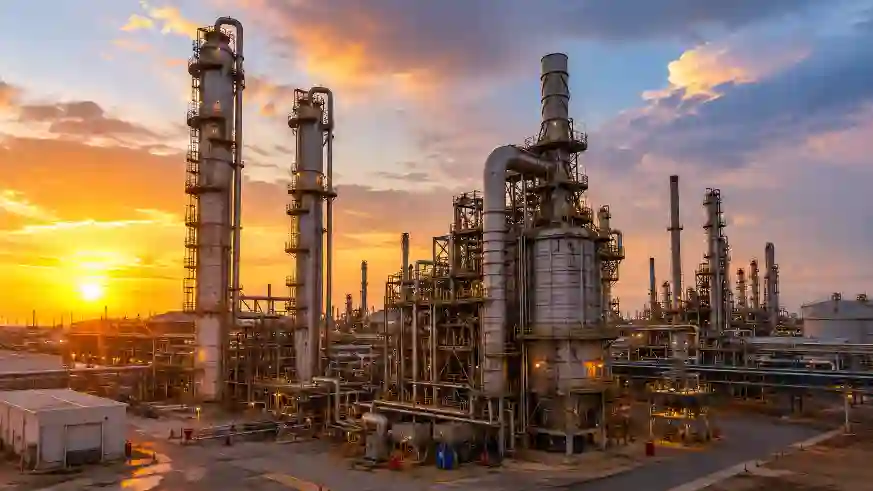
What Is the Catalytic Reforming Process?
The catalytic reforming process is a refinery method that rearranges hydrocarbon molecules to make better fuel.
Think of it like reorganizing furniture in a room. You are not adding new furniture or throwing anything away — you are just moving things around so the room works better.
Crude oil contains a fraction called naphtha. On its own, naphtha has low octane. Low-octane fuel causes engine knocking, which wastes energy and damages engines. The catalytic reforming process fixes this problem.
It uses heat, pressure, and a platinum catalyst to reshape the naphtha molecules into:

Why Does This Process Matter in a Refinery?
Modern car engines need high-octane fuel to run properly. Straight-run naphtha from crude oil typically has an octane number of around 60–70. Most modern engines need 91 or higher.
That gap is the problem the catalytic reforming process solves.
Here is why refineries depend on it:
1. It boosts gasoline octane. The research octane number (RON) can go from around 60–70 all the way up to 95 or higher after reforming. That meets modern fuel standards.
2. It produces hydrogen. Hydrogen is not just a by-product — it is gold for refineries. Other units in the refinery use it to remove sulfur from diesel, jet fuel, and gasoline. Countries like India require fuel sulfur below 10 ppm under Bharat Stage VI (BS-VI) rules. Without hydrogen from reformers, that level is hard to reach.
One important thing: Catalytic reforming is NOT the same as cracking. Cracking breaks big molecules into smaller ones. Reforming mainly rearranges molecules. The size stays roughly the same — the shape changes.
How Does the Catalytic Reforming Process Work? Step by Step
Step 1 — Feed Preparation
The feed is naphtha — usually with a boiling range of about 80°C to 180°C.
Before entering the reformer, the naphtha goes through hydrotreating. This step removes sulfur, nitrogen, and metals. Why? Because these substances poison the platinum catalyst. A poisoned catalyst stops working properly.
Inspector tip: If catalyst activity drops suddenly, the first thing operators check is sulfur leaking through from the upstream hydrotreater.
Step 2 — Heating in the Charge Heater
The clean naphtha is heated in a large fired heater to around 480–525°C before entering the reactors. The pressure is typically 5–35 barg, depending on the unit type.
Operators watch heater tube temperatures closely. Overheating causes coke (carbon deposits) to build up inside the tubes — and that leads to damage.
Step 3 — Conversion in the Reactors
The hot naphtha passes through 3 or 4 reactors filled with platinum-rhenium catalyst on an alumina support.
The catalyst causes several chemical reactions:
| Reaction | What It Does |
|---|---|
| Dehydrogenation | Turns ring-shaped naphthenes into aromatics |
| Dehydrocyclization | Converts straight-chain paraffins into rings |
| Isomerization | Rearranges paraffins into branched shapes |
| Hydrocracking | Breaks a few molecules into smaller ones |
The reactions are endothermic — they absorb heat. So the gas cools down across each reactor. To fix this, interheaters reheat the gas between reactors, keeping the process going.
Step 4 — Product Separation
After the reactors, the hot gas and liquid mixture goes into a separator. Here:
- Hydrogen-rich gas is separated from the liquid
- The gas is recycled back into the reactors to prevent coke buildup
- Hydrogen purity in the gas can reach 70–90%
Inspector note: Separators can suffer from ammonium salt deposits if contamination sneaks in upstream.
Step 5 — Stabilization
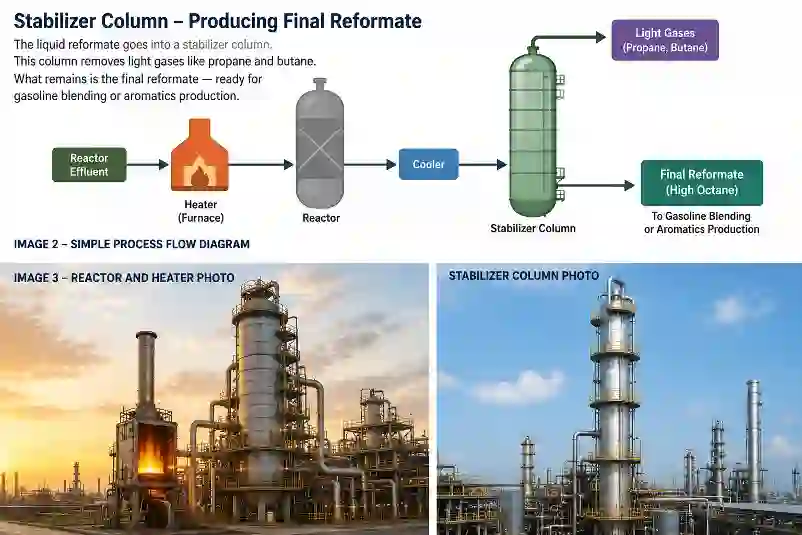
The liquid reformate goes into a stabilizer column. This column removes light gases like propane and butane. What remains is the final reformate — ready for gasoline blending or aromatics production.
Key Equipment in a Catalytic Reforming Unit
Charge Heater
Heats naphtha to reactor temperature (~500°C).
What inspectors look for: Hot spots on tubes, creep damage, and signs of carburization in older units. Infrared (IR) thermography is often used during operation.
Reforming Reactors
Usually 3–4 radial-flow reactors in series. They run at 480–525°C with high hydrogen pressure inside.
What inspectors look for: Risk of High Temperature Hydrogen Attack (HTHA) in older carbon steel sections. API 941 Nelson curves and API 571 are the main guides for assessing this risk.
Recycle Gas Compressor
Pumps hydrogen-rich gas back into the reactors. Keeps coke from forming on the catalyst.
What inspectors look for: Vibration issues, seal problems, and corrosion at knockout drums from sour condensate.
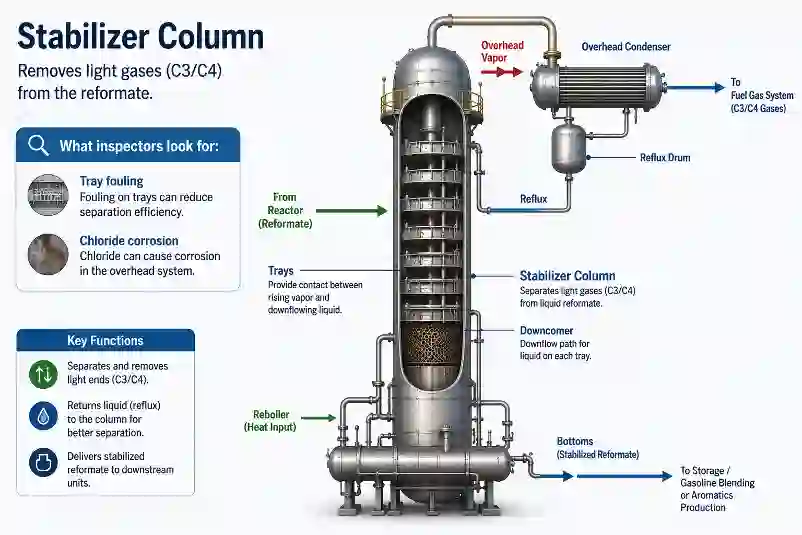
Stabilizer Column
Removes light gases (C3/C4) from the reformate.
What inspectors look for: Tray fouling and chloride corrosion in the overhead system.
What Does the Catalytic Reforming Process Produce?
| Product | Key Spec | Main Use |
|---|---|---|
| Reformate | RON 95–102 | Gasoline blending |
| Hydrogen | 70–90% purity | Hydrotreating units |
| LPG | C3/C4 mix | LPG recovery |
| Fuel gas | Light hydrocarbons | Fired heater fuel |
Reformate is the main product — a high-octane liquid that goes into gasoline blending pools or aromatics extraction plants (for benzene, toluene, and xylene).
Hydrogen is the most valuable by-product. Refineries depend on it to produce clean, low-sulfur fuels.
Common Problems Inspectors Find in Reforming Units
1. Catalyst Deactivation
Cause: Coke buildup, sulfur poisoning, or chloride imbalance. How it’s found: Process monitoring, performance trending, visual inspection at shutdown. Standard: API 571.
2. High Temperature Hydrogen Attack (HTHA)
Cause: Hydrogen reacts with carbon in steel at high temperatures, weakening the metal from inside. Where it happens: Often in transfer lines near reactor outlets — not always in the reactor itself. How it’s found: Advanced ultrasonic testing (UT), TOFD, metallography. Standard: API 941, API 571.
3. Chloride Stress Corrosion Cracking
Cause: Chlorides from catalyst regeneration collect in condensate systems downstream. How it’s found: UT scanning, radiographic testing (RT), positive material identification (PMI), visual inspection. Standard: ASME Section VIII.
4. Furnace Tube Overheating
Cause: Coke deposits inside tubes or uneven burner flame (flame impingement). How it’s found: IR thermography, on-stream tube thickness measurements.
Many failures begin with a single burner flame impingement event that was missed during overnight rounds.
Catalytic Reforming vs Hydrocracking — What Is the Difference?
Both are refinery conversion processes, but they work very differently.
| Parameter | Catalytic Reforming | Hydrocracking |
|---|---|---|
| Feed | Heavy naphtha | Vacuum gas oil |
| Pressure | 5–35 barg | 80–200 barg |
| Temperature | 480–525°C | 350–430°C |
| Main Products | Reformate, hydrogen | Diesel, jet fuel, naphtha |
| Main Purpose | Raises octane | Breaks large molecules |
| Location in Refinery | Gasoline complex | Conversion complex |
The simple version: reforming rearranges molecules to raise octane. Hydrocracking breaks molecules into smaller, more useful products. Different goals, different equipment, different inspection priorities.
Frequently Asked Questions
What does catalytic reforming do in simple terms?
It takes low-quality naphtha from crude oil and converts it into high-octane gasoline and hydrogen. It does this by rearranging hydrocarbon molecules using heat and a platinum catalyst.
What is the main product of the catalytic reforming process?
The main product is reformate — a high-octane liquid used in gasoline blending. Hydrogen is the most valuable by-product.
What is the full form of CRU in a refinery?
CRU stands for Catalytic Reforming Unit. Some older refineries also call it a Platformer (a trademarked term from UOP).
What pressure does catalytic reforming operate at?
Most units operate between 5 and 35 barg. Continuous Catalyst Regeneration (CCR) units run at lower pressure to get higher aromatic yield.
Why is hydrogen recycled in the catalytic reforming process?
Recycled hydrogen suppresses coke formation on the catalyst surface. Less coke means longer catalyst life and more stable operation.
What is the biggest corrosion risk in catalytic reforming?
Two risks stand out: High Temperature Hydrogen Attack (HTHA) in hot, high-pressure circuits, and chloride stress corrosion cracking in downstream condensate systems.
Is catalytic reforming the same as cracking?
No. Reforming mainly rearranges molecules without significantly reducing their size. Cracking breaks large molecules into smaller ones. They serve very different purposes in a refinery.
What is the difference between semi-regenerative and CCR reforming?
In a semi-regenerative unit, the entire plant shuts down periodically to regenerate the catalyst. In a CCR (Continuous Catalyst Regeneration) unit, catalyst is continuously removed, regenerated in a separate vessel, and returned — so the plant never needs to stop.
What is one practical inspection tip for reformers?
Always inspect transfer line elbows near reactor outlets during shutdown. These spots often show unexpected thinning from temperature cycling — and they are easy to miss.
Key Takeaways
- The catalytic reforming process converts low-octane naphtha into high-octane reformate and hydrogen.
- It uses a platinum-rhenium catalyst at 480–525°C and 5–35 barg pressure.
- The process rearranges molecules — it does NOT crack them into smaller pieces.
- Key products: reformate (gasoline blending), hydrogen (hydrotreating), LPG, and fuel gas.
- Main inspection concerns: HTHA in transfer lines, chloride corrosion in overhead systems, and heater tube damage.
- For inspectors: always check transfer line elbows and heater tubes closely during shutdown.
Suggested Posts
What Is a Hydrotreating Unit? Process, Working and Purpose Explained
DHT Unit in Refinery: What It Is, How It Works, and Why It Matters
What Does FCC Mean in a Refinery? Here’s the Truth
What is a VDU Unit? Meaning, Process and Working Explained
About The Author
