
Introduction
In any refinery, everything starts with the Crude Distillation Unit, or CDU. No matter how advanced the refinery is, the first job is always the same: separate crude oil into useful parts.
Many people read about the crude oil distillation process in books, but when you see it in the field, it becomes much easier to understand. Crude oil is not a single substance. It is a mixture of many hydrocarbons, some light and some very heavy. The job of the CDU is to separate this mixture in a simple and controlled way.
This article explains how crude oil is separated in a refinery using simple language and a practical approach. If you are a student, a junior engineer, or an inspector, this will help you understand what is really happening inside the unit.
What is a Crude Distillation Unit
A Crude Distillation Unit is the first processing unit in a refinery where crude oil is separated into different fractions based on boiling points.
There is no chemical reaction in this step. The CDU process in refinery is only about heating, vaporizing, cooling, and separating. Because this separation happens at normal pressure, it is also called atmospheric distillation of crude oil.
In simple words, the CDU takes crude oil and splits it into lighter and heavier products so that each one can be processed further.
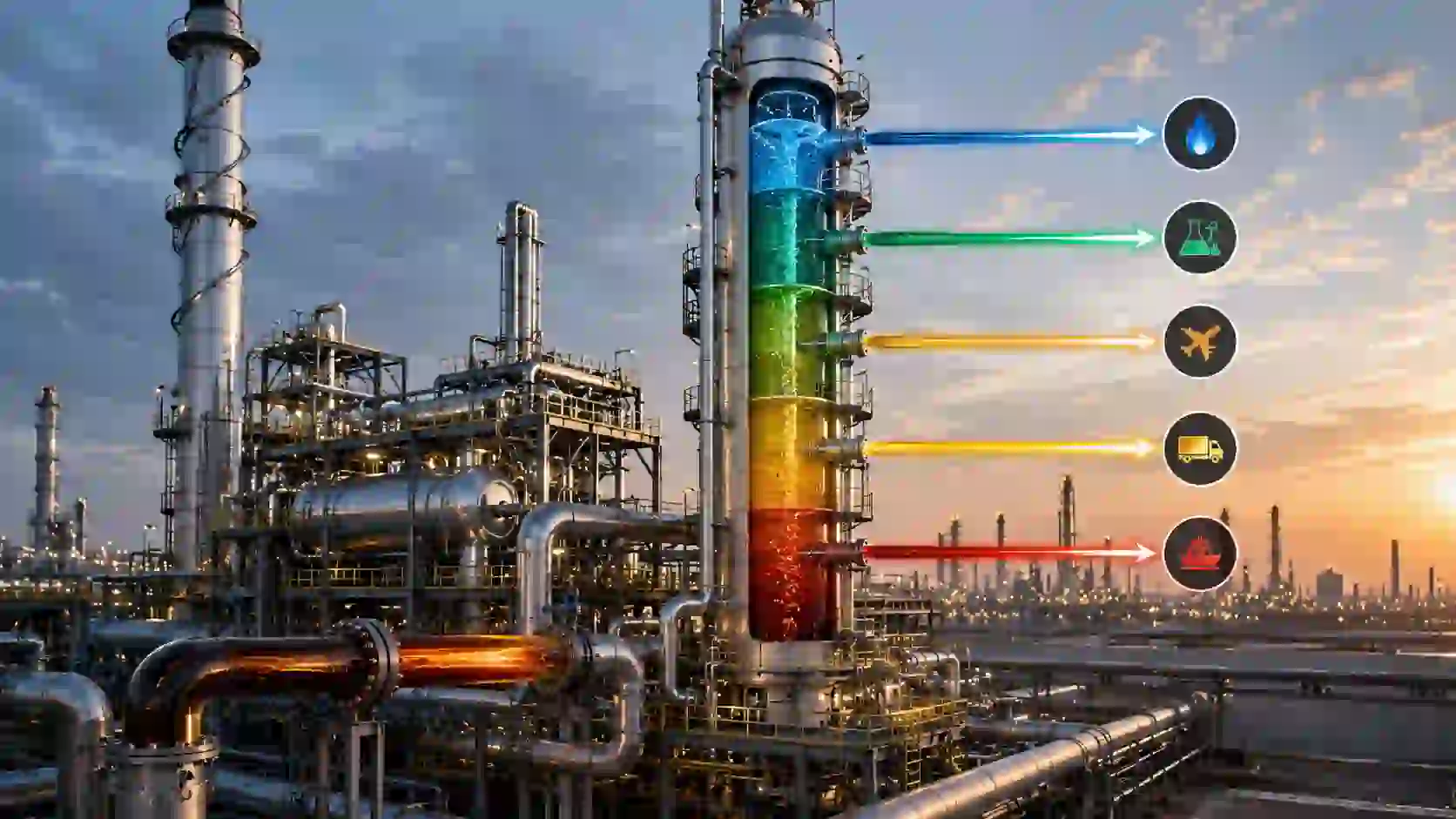
How crude oil is separated in a refinery
If you stand near a CDU (from a safe distance), what you will notice first is the tall distillation column. This column is where the main separation happens.
The idea is simple. When crude oil is heated, different parts of it boil at different temperatures. Light components boil quickly and move upward. Heavy components need more heat and tend to stay at the bottom.
Inside the column, there are trays or structured packing. As vapors rise, they cool down. When the temperature becomes suitable, they condense into liquid and are collected at that level.
This is the basic answer to how crude oil is separated in a refinery. It is not complicated, but controlling it properly is what makes the difference.
Crude distillation unit working principle
The crude distillation unit working principle is based on temperature difference across the column.
At the bottom of the column, the temperature is very high. At the top, it is much lower. This temperature gradient allows different hydrocarbons to separate naturally.
In real operation, it is not just about heating crude oil and sending it to the column. Operators must maintain:
- Correct furnace temperature
- Proper column pressure
- Stable reflux at the top
If any of these go wrong, separation quality drops.
From an inspector’s point of view, this is important. When you see off-spec products or unusual temperatures, it usually means something inside the unit is not working as expected.
Step-by-step crude oil distillation process
Let’s walk through the crude oil distillation process in a way that matches what actually happens in a refinery.
The crude oil first enters the desalter. In the field, this is a critical piece of equipment. If desalting is not done properly, salts will enter the system and cause corrosion, especially in the overhead section.
After desalting, the crude oil is preheated. This is done using heat exchangers. You will often see a network of exchangers before the furnace. This helps save energy by using heat from product streams.
Next comes the furnace. This is one of the most sensitive areas in CDU operation and equipment. The crude is heated to around 350 to 400 degrees Celsius. If the temperature is too low, separation will be poor. If it is too high, you may start forming coke inside the tubes.
Once heated, the crude enters the distillation column. Inside the column, separation begins immediately. Vapors rise, liquids fall, and different fractions settle at different levels.
At the top, you get lighter gases. In the middle, you get naphtha, kerosene, and diesel. At the bottom, heavy residue is collected.
This entire sequence is what we call the initial separation of crude oil process.
Products from atmospheric distillation of crude oil
The atmospheric distillation of crude oil produces several important products. Each one has a specific use.
At the top of the column, you will find light gases. These are often used as fuel within the refinery.
Below that, naphtha is collected. This is an important feed for petrol production and petrochemicals.
Further down, kerosene is obtained. In many refineries, this goes for jet fuel processing.
Diesel is collected below the kerosene section. This is one of the most valuable products in many markets.
At the bottom, you have atmospheric residue. This is a heavy material that cannot be processed further in the CDU. It is sent to the vacuum distillation unit.
From a field perspective, each draw-off point must be monitored carefully. Any contamination between streams can affect product quality.
CDU operation and equipment in real conditions
When we talk about CDU operation and equipment, it is easy to list components. But in the field, what matters is how they behave over time.
The desalter must be checked regularly. Poor performance here leads to bigger problems later.
The furnace needs close monitoring. Tube overheating is a real risk. Inspectors often look for signs like hot spots or uneven flame patterns.
The distillation column may look fine from outside, but internal problems like tray damage or fouling can affect performance. These are not always easy to detect without proper checks.
Heat exchangers are another area where issues develop slowly. Fouling reduces heat transfer, and over time, this increases fuel consumption in the furnace.
Pipelines and overhead systems are common areas for corrosion. This is especially true in units handling high sulfur crude.
Common issues seen in CDU units
In real refinery operation, the CDU is stable most of the time, but certain problems come up again and again.
Corrosion is one of the biggest concerns. It often starts small but can become serious if not controlled.
Fouling is another common issue. You may not notice it immediately, but it reduces efficiency over time.
Furnace-related problems are also critical. Even a small deviation in temperature can affect the whole unit.
Sometimes, the column may not separate properly. This can happen due to pressure changes, tray issues, or improper reflux.
These are not just theory points. These are real problems that inspectors and operators deal with regularly.
Why understanding CDU matters in the field

The CDU process in refinery may look simple on paper, but in reality, it controls the entire refinery performance.
If the CDU is running well, downstream units receive proper feed. If not, everything else suffers.
For inspectors, understanding the crude distillation unit working principle helps in identifying early warning signs. Small observations can prevent major failures.
For students and fresh engineers, learning how crude oil is separated in a refinery gives a strong base for understanding all other refining processes.
Conclusion
The Crude Distillation Unit is where the refinery process truly begins. It carries out the initial separation of crude oil process using simple physical principles, but its impact is very large.
By heating crude oil and separating it based on boiling points, the CDU produces useful fractions that are further processed into fuels and other products.
Understanding the crude oil distillation process is not just about theory. It is about knowing how the unit behaves in real conditions. From furnace operation to column performance, every part plays a role.
For anyone working in or around refineries, having a clear idea of CDU operation and equipment is essential. It improves safety, efficiency, and overall plant reliability.
FAQs
1. What is a Crude Distillation Unit
A Crude Distillation Unit is a refinery unit that separates crude oil into different fractions using heat and boiling point differences.
2. What is the crude distillation unit working principle
It is based on heating crude oil and separating components in a column where each fraction condenses at a different temperature.
3. How crude oil is separated in a refinery
Crude oil is heated, partially vaporized, and then separated in a distillation column based on boiling points.
4. What is atmospheric distillation of crude oil
It is the process of separating crude oil at normal pressure inside a distillation column.
5. What are the main products of CDU
The main products are gases, naphtha, kerosene, diesel, and atmospheric residue.
6. What is the CDU process in refinery
It is the first step in refining where crude oil is separated into useful fractions.
7. What are common problems in CDU operation
Common problems include corrosion, fouling, furnace overheating, and poor separation.
8. Why is CDU important
It is important because it affects the performance, safety, and efficiency of the entire refinery.
Suggested Posts
Epoxy Coating Failure: Causes, Defects, Blistering and Prevention
Coating Blistering: Causes, Prevention & Role of Chloride Contamination
Pipeline Coating Failure: Why FBE Coatings Fail in the Field
Best Industrial Coatings for Corrosion Protection: 11 Types Explained
About The Author
