
Introduction- What Does FCC Mean in a Refinery?
Have you ever wondered how crude oil — that thick, dark liquid pulled out of the ground — turns into the fuel that powers your car? It doesn’t happen by magic. There’s a fascinating process behind it, and one of the most important steps is something called FCC. So, what does FCC mean in a refinery? Simply put, FCC stands for Fluid Catalytic Cracking — a process that breaks down heavy oil into lighter, more useful products like gasoline, diesel, and jet fuel.
If that sounds complicated, don’t worry. By the end of this article, you’ll understand exactly what an FCC unit is, how it works, and why it matters so much to the oil and gas industry. We’ll keep everything simple and easy to follow — no engineering degree required!
What Is FCC in a Refinery?
Let’s start from the beginning. A petroleum refinery is basically a giant factory that takes crude oil and turns it into useful products. But not all crude oil is the same. Some of it is heavy and thick, with large molecules that can’t be used directly as fuel.
That’s where the FCC unit in a refinery comes in.
The Fluid Catalytic Cracking process takes those big, heavy oil molecules and cracks them into smaller, lighter molecules. Think of it like breaking a big chocolate bar into smaller pieces — each piece is easier to use and more valuable.
The word “fluid” here doesn’t mean water or any liquid in the usual sense. It refers to the fact that the catalyst (a special chemical substance) flows like a fluid during the process. The word “catalytic” means the process uses a catalyst to speed up the chemical reaction. And “cracking” means breaking apart large molecules into smaller ones.
So, FCC = breaking heavy oil molecules using a flowing catalyst.
Why Is the FCC Unit So Important?
Here’s something that might surprise you: crude oil on its own isn’t very useful. You can’t pour crude oil into your car and expect it to run. It needs to be refined and processed first.
Out of all the processes in a refinery, the FCC operation is one of the most profitable. Here’s why:
- It converts heavy, low-value oil into high-value products like gasoline
- It increases the yield of gasoline — which is what most refineries want more of
- It helps refineries make the most out of every drop of crude oil
- It plays a huge role in meeting global fuel demand
In fact, a large portion of the world’s gasoline supply is produced through the fluid catalytic cracking process. Without FCC units, fuel would be much more expensive and harder to produce.
A Brief History of Catalytic Cracking
Before we dive deeper, let’s take a quick look back.
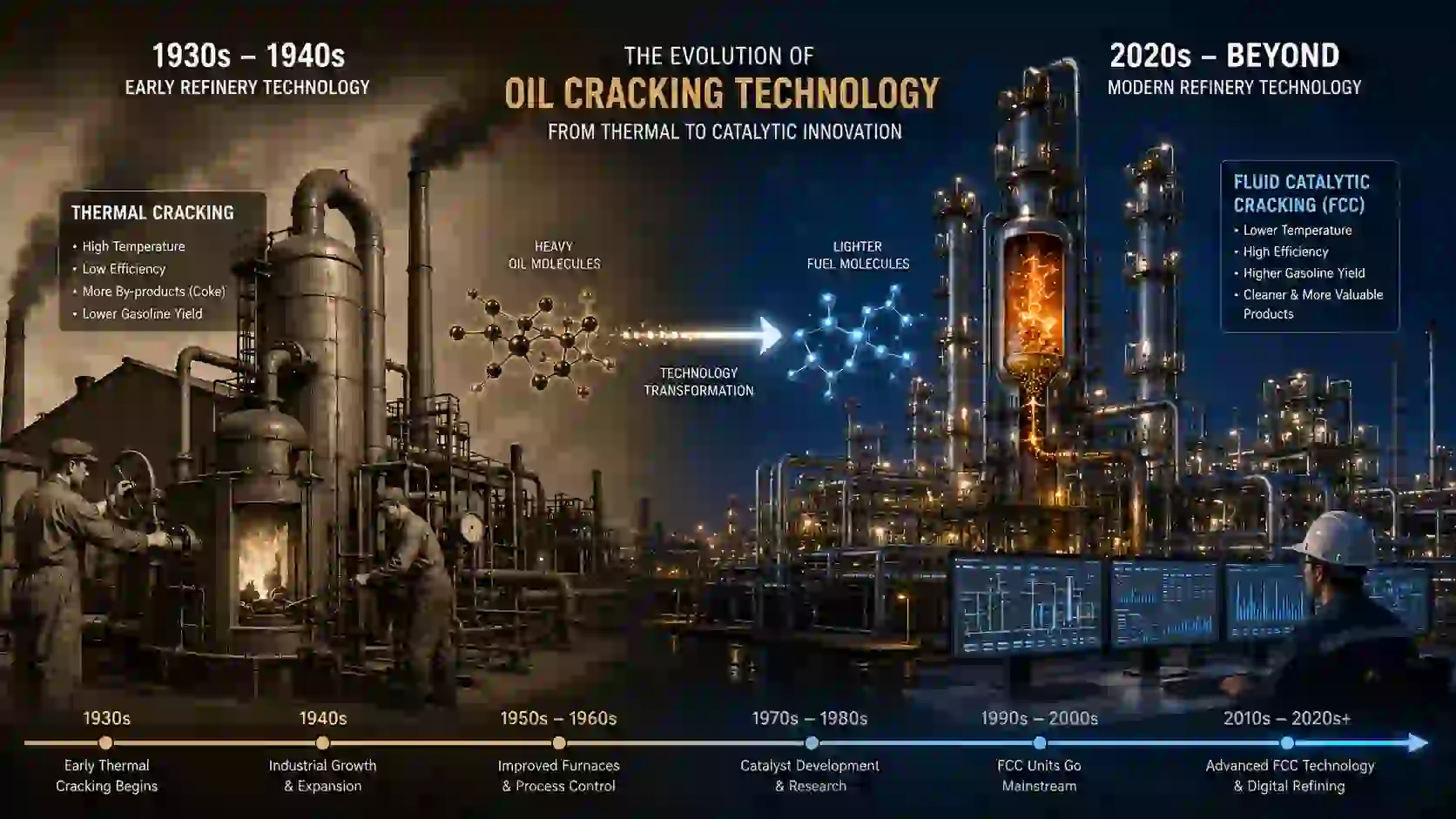
The idea of cracking oil isn’t new. Early refiners used something called thermal cracking — using heat alone to break oil molecules. But thermal cracking had its limits. It wasn’t very efficient, and the fuel it produced wasn’t always great quality.
In the 1930s and 1940s, engineers developed a better method — catalytic cracking. By using a catalyst, they could crack oil more efficiently and produce better-quality gasoline.
The first commercial FCC unit started operating in 1942 in the United States. Since then, the technology has improved dramatically. Today, modern FCC units are highly sophisticated and are found in refineries all over the world.
How Does the FCC Process Work? Step by Step
Now let’s get into the real heart of it — how does this whole fluid catalytic cracking process actually work?
Step 1 — The Feed Enters the Riser
The heavy oil that enters the FCC unit is called the feed or feedstock. This is usually a heavy fraction of crude oil called vacuum gas oil (VGO) or sometimes atmospheric residue.
This heavy oil is heated and injected into a tall vertical pipe called the riser. Inside the riser, the hot oil meets the catalyst — a fine powder made mostly of zeolite (a naturally occurring mineral with special properties).
When the hot oil mixes with the catalyst, the cracking reaction happens almost instantly. The heavy molecules break apart into smaller ones.
Step 2 — Separation in the Reactor
After the cracking reaction, the mixture of cracked products and catalyst travels up the riser into the reactor vessel. Here, the catalyst separates from the cracked hydrocarbon vapors using a device called a cyclone separator.
The cracked vapors move on to be processed further. The catalyst, however, has a problem — during the cracking process, a substance called coke (a carbon deposit) builds up on its surface. This makes the catalyst less effective.
Step 3 — Catalyst Regeneration
This is one of the cleverest parts of the FCC process. The spent catalyst is sent to a separate vessel called the regenerator.
Inside the regenerator, air is blown through the catalyst. This burns off the coke deposits in a process called combustion. The heat generated here is actually used to help heat the feed — making the whole process more energy-efficient.
Once the coke is burned off, the catalyst is clean and hot again. It’s then recycled back to the riser to repeat the whole process. This is a continuous cycle — catalyst constantly flows between the riser, reactor, and regenerator.
Step 4 — Fractionation of Products
The cracked vapors that came out of the reactor are sent to a tall distillation column called the main fractionator. Here, the different products are separated based on their boiling points:
- Gasoline — the most valuable product, used as car fuel
- LPG (Liquefied Petroleum Gas) — used for cooking and heating
- Light cycle oil (LCO) — used in diesel blending
- Heavy cycle oil (HCO) — used as fuel oil or recycled back
- Dry gas — used as refinery fuel
Each of these products is sent to further processing units before it’s ready to use.
Key Parts of an FCC Unit
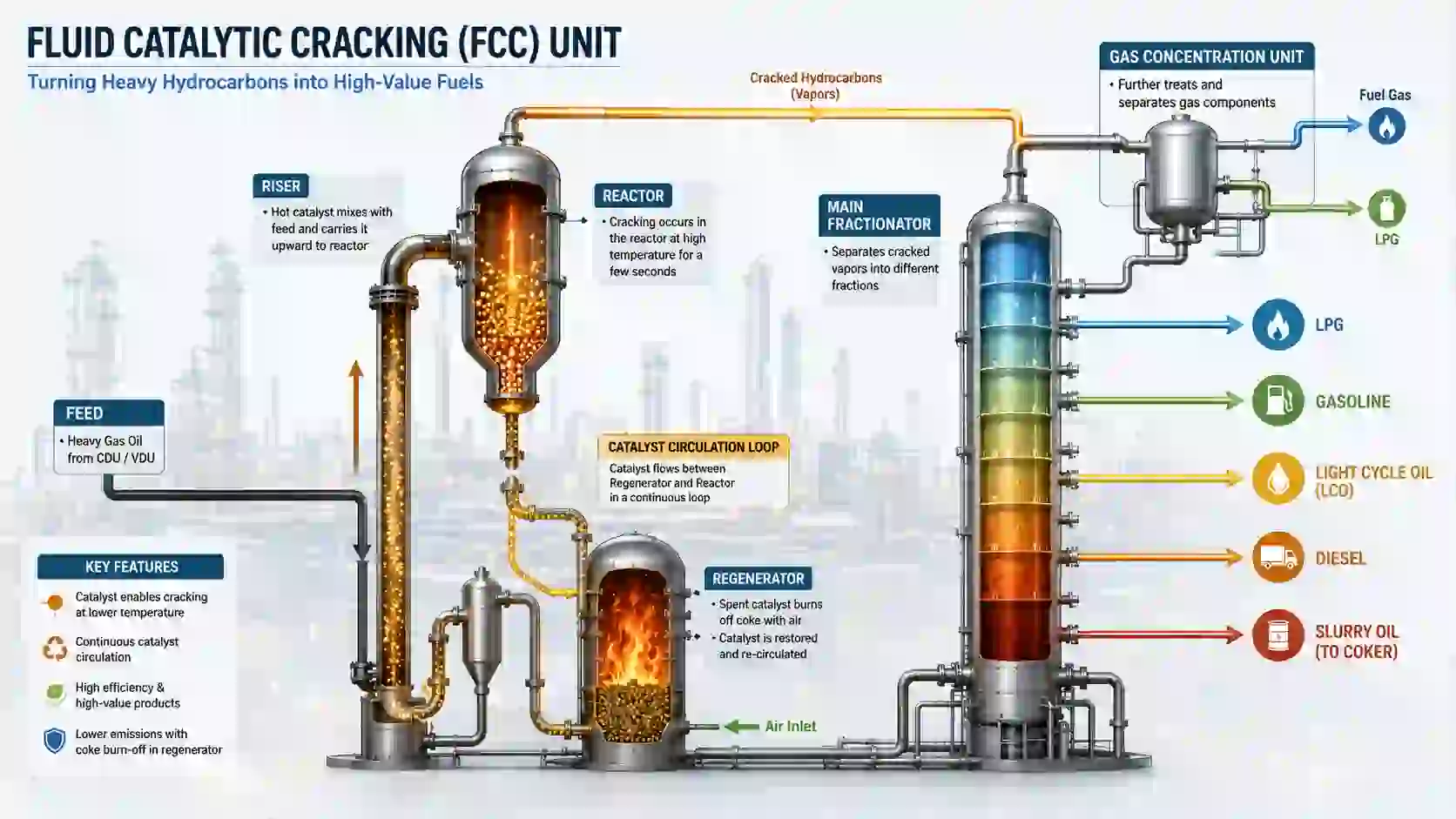
Let’s look at the main components that make up a typical FCC unit:
| Component | Role |
| Riser | Where the cracking reaction takes place |
| Reactor | Separates catalyst from cracked vapors |
| Regenerator | Burns off coke from catalyst; regenerates it |
| Main Fractionator | Separates cracked products |
| Gas Concentration Unit | Further separates lighter products |
| Catalyst | The “magic ingredient” that makes cracking happen |
Each part plays a critical role. If any one of them fails or underperforms, the whole unit can suffer.
What Kind of Catalyst Is Used in FCC?
The catalyst is truly the star of the show in fluid catalytic cracking.
Modern FCC catalysts are made up of several components, but the most important is zeolite — specifically a type called Y-zeolite. Zeolite has a very porous structure, which gives it a huge surface area in a tiny amount of material. This helps the cracking reactions happen quickly and efficiently.
The catalyst also contains:
- Matrix materials — to crack larger molecules before they reach the zeolite
- Binders — to hold everything together
- Additives — to control specific reactions or reduce pollutants
FCC catalyst looks like a fine powder — similar in texture to talcum powder. During operation, it behaves almost like a liquid as it flows through the system, which is why it’s called “fluid” catalytic cracking.
Over time, some catalyst is lost and must be replaced. Refineries add fresh catalyst daily to maintain performance.
What Products Come Out of an FCC Unit?
This is where the real value shows up. A well-run FCC operation in a refinery can produce a range of useful products:
Gasoline (Petrol)
This is the most important product. FCC gasoline makes up a significant portion of the total gasoline pool in most refineries. It has decent octane quality, which makes it suitable for blending into regular and premium fuel grades.
LPG (Liquefied Petroleum Gas)
LPG is the gas that comes in cylinders used for cooking in homes across India and around the world. A good chunk of LPG comes from FCC units.
Diesel Blendstock
The light cycle oil from the FCC unit can be blended with other streams to produce diesel fuel.
Petrochemical Feedstocks
Some FCC units are specially configured to produce propylene and other chemicals used in the petrochemical industry — for making plastics, detergents, and more.
FCC vs. Other Cracking Processes — What’s the Difference?
You might have heard of other cracking processes too. Let’s do a quick comparison so everything is clear.
FCC vs. Hydrocracking
Both FCC and hydrocracking break heavy oil into lighter products. But they do it differently:
- FCC uses a catalyst and high temperature (around 500°C)
- Hydrocracking uses a catalyst AND hydrogen gas under high pressure
- FCC is better for making gasoline; hydrocracking is better for making diesel
- FCC is generally faster and less expensive to run
FCC vs. Thermal Cracking
Thermal cracking uses heat alone (no catalyst). It’s older technology and less efficient. FCC produces better-quality products and higher yields, which is why it replaced thermal cracking in most applications.
Challenges and Limitations of FCC Operations
Nothing is perfect, and the FCC unit is no different. Operators and engineers face real challenges every day:
- Feedstock Quality If the crude oil entering the refinery is very heavy or contains a lot of metals (like nickel and vanadium), it can damage the catalyst. Refineries must carefully choose and pre-treat their feedstock.
- Catalyst Management Catalyst is expensive. Managing how much to add, when to change it, and how to dispose of spent catalyst is an ongoing challenge.
- Coke Formation Too much coke on the catalyst reduces efficiency. Operators must carefully balance the regeneration cycle.
- Environmental Concerns The FCC regenerator releases gases including sulfur dioxide (SO₂) and particulate matter. Modern FCC units use advanced emission control systems to minimize this.
- Product Quality FCC gasoline has some sulfur content that needs to be removed in a downstream unit called a hydrotreater before it meets fuel quality standards.
Modern Advances in FCC Technology
The petroleum refining process keeps getting better. Here are some exciting developments in FCC technology:
- Deep catalytic cracking (DCC): A modified FCC design that produces more propylene for the petrochemical industry
- Residue FCC (RFCC): Designed to process even heavier, lower-quality feeds like atmospheric residue
- Closed-loop catalyst addition systems: Improve catalyst management and reduce waste
- Advanced emission controls: New designs that reduce SO₂, NOx, and particulate emissions significantly
Refineries are also looking at ways to make FCC units more energy-efficient and reduce their carbon footprint — an important goal in today’s world.
FCC in the Indian Refining Context
India is one of the largest oil refining nations in the world. Major refineries operated by companies like Indian Oil Corporation (IOC), Bharat Petroleum (BPCL), Hindustan Petroleum (HPCL), and Reliance Industries all operate large FCC or RFCC units.
Given the rising demand for petrol, LPG, and petrochemicals in India, FCC units play a critical role in meeting domestic fuel needs. The Indian refining sector continues to invest in upgrading and expanding FCC capacity to process heavier crudes and produce cleaner fuels.
How FCC Relates to Everyday Life
You might be thinking — okay, this is interesting, but what does it have to do with me?
Quite a lot, actually.
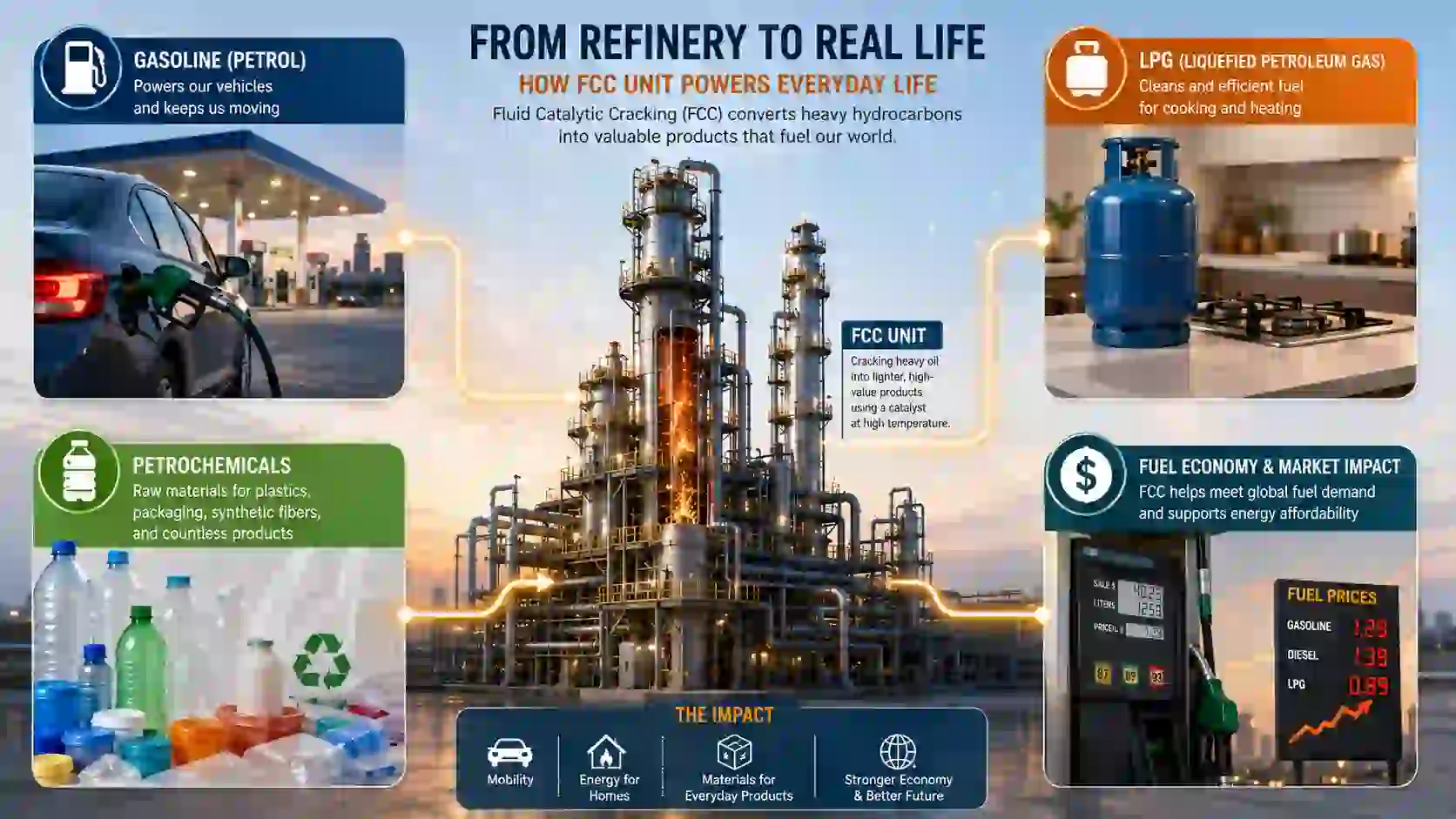
- The petrol in your car or bike — much of it was produced in an FCC unit
- The LPG cylinder in your kitchen — contains gases from FCC and other refinery processes
- The plastic bottles and packaging you use — often made from petrochemicals derived from FCC products
- The price of fuel at the pump — partly depends on how efficiently refineries run their FCC operations
So every time you fill up your tank, you’re benefiting from a process that’s been running continuously, day and night, in refineries around the world.
Conclusion
So now you know the answer to the question — what does FCC mean in a refinery? It means Fluid Catalytic Cracking, and it’s one of the most important and impressive processes in the entire petroleum refining world.
From breaking down heavy oil molecules to producing the gasoline that powers millions of vehicles every day, the FCC unit is truly the workhorse of a modern refinery. It’s a perfect blend of chemistry, engineering, and clever design — all working together continuously to keep the world’s energy supply running smoothly.
Whether you’re a student just learning about refinery processes, someone curious about the oil and gas industry, or a professional looking for a clear refresher, we hope this guide helped you understand FCC in a simple and memorable way.
The next time you ride past a refinery with those tall towers and flames, you’ll know — somewhere in there, an FCC unit is hard at work, cracking heavy oil into something useful for everyone.
Frequently Asked Questions (FAQs)
-
What does FCC mean in a refinery?
FCC stands for Fluid Catalytic Cracking. It’s a key refinery process that breaks down heavy oil into lighter products like gasoline, LPG, and diesel. It’s one of the most important units in any modern petroleum refinery.
-
What is the main purpose of an FCC unit?
The main job of an FCC unit is to convert heavy, less valuable oil fractions into lighter, more valuable products — especially gasoline. It helps refineries get the most out of crude oil.
-
What catalyst is used in the FCC process?
FCC uses a powdered catalyst made mainly of zeolite (Y-zeolite), along with matrix materials and various additives. This catalyst flows like a fluid during the process, which is why it’s called “fluid” catalytic cracking.
-
What products does an FCC unit produce?
An FCC unit produces several products including gasoline (petrol), LPG, light cycle oil (used in diesel), heavy cycle oil, dry gas, and in some cases propylene for petrochemicals.
-
How is FCC different from hydrocracking?
Both processes convert heavy oil, but FCC uses heat and catalyst without hydrogen, while hydrocracking uses hydrogen gas under high pressure. FCC is better suited for gasoline production; hydrocracking is better for diesel.
-
Is the FCC catalyst reused or wasted?
It’s reused! The catalyst continuously circulates between the reactor and the regenerator. In the regenerator, the coke built up on the catalyst is burned off, and the clean catalyst goes back to crack more oil. Fresh catalyst is added gradually to replace losses.
-
Why is the FCC process considered so profitable for refineries?
Because it turns low-value heavy oil — which can’t be directly sold as fuel — into high-value products like gasoline and LPG. This “upgrading” of crude oil is where refineries make much of their profit.
-
Are there any environmental concerns with FCC units?
Yes, the regenerator in an FCC unit releases gases like SO₂ and some particulate matter. However, modern refineries use advanced emission control systems such as flue gas scrubbers and electrostatic precipitators to significantly reduce these emissions and meet environmental standards.
Suggested Posts
What is a VDU Unit? A Simple Answer Before We Go Deeper
Crude Distillation Unit (CDU): How Crude Oil is Separated
Coating Blistering: Causes, Prevention & Role of Chloride Contamination
Coating Inspection Standards (ASTM & ISO): Field Reference Guide for Inspectors
About The Author
