
An amine recovery unit (ARU) is a refinery process unit that regenerates rich amine by removing absorbed hydrogen sulfide (H₂S) and carbon dioxide (CO₂), allowing the solvent to be reused in gas sweetening systems. It is essential for sulfur recovery and refinery environmental compliance.
In practice, without a reliable ARU, refineries would quickly lose the ability to meet product sulfur specifications or safely handle sour gases, leading to operational shutdowns or environmental violations. This unit sits at the heart of the refinery’s sulfur management system, feeding concentrated acid gas to the Sulfur Recovery Unit (SRU).

Featured Snippet Block Put simply: An amine recovery unit, or ARU, regenerates rich amine loaded with H₂S and CO₂ by heating it in a stripper column to release the acid gases. The resulting lean amine returns to absorbers throughout the refinery. Typical regeneration occurs at 100–130°C and low pressure, enabling continuous amine recycling while sending acid gas to the SRU for sulfur production.
What Is an Amine Recovery Unit? A Simple Answer Before We Go Deeper
An amine recovery unit is the regeneration section of the broader amine treating system. Sour gases and liquids from various refinery units (such as hydrotreaters, FCC, cokers, and fuel gas systems) contact lean amine in absorbers. The amine chemically binds with H₂S and CO₂, becoming “rich amine.” This rich stream then flows to the ARU, where heat and steam strip the acid gases, restoring the amine’s capacity.
In my 15+ years inspecting and troubleshooting these systems, I’ve seen ARUs handling anywhere from a few tons to over 100 tons per day of amine circulation, depending on the refinery’s sour gas load.
Why Does an Amine Recovery Unit Matter in a Refinery?
Acid gases must be removed to meet stringent product quality specs, protect downstream catalysts, and comply with environmental regulations. The ARU makes this economically feasible by recycling expensive amine solvents rather than continuously replacing them.
It also concentrates H₂S for safe feeding into the Claus SRU, where it converts to elemental sulfur. Without effective regeneration, amine degradation accelerates, corrosion rates skyrocket, and the entire sweetening process collapses. In today’s low-sulfur fuel environment, a well-performing ARU is non-negotiable for on-spec gasoline, diesel, and fuel gas production.
How Does an Amine Recovery Unit Work? — Step by Step
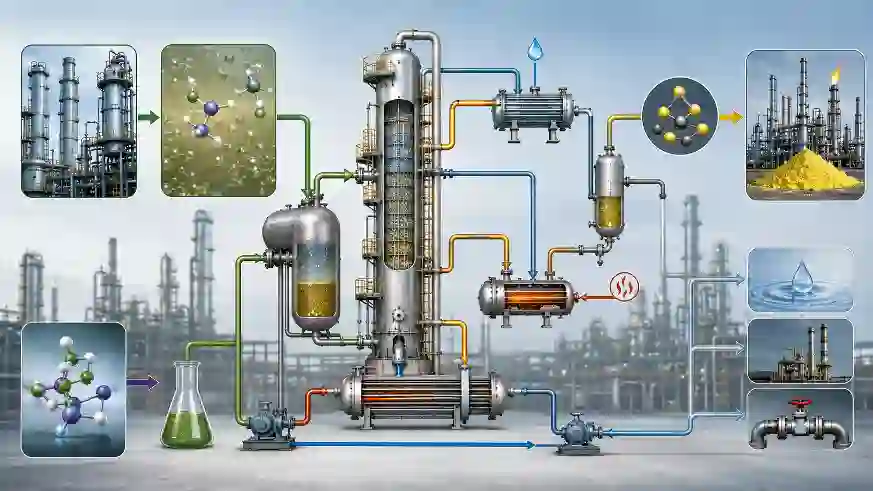
Here’s the typical process flow in a refinery ARU:
- Rich Amine Collection and Flash — Rich amine from multiple absorbers collects in a header and enters a rich amine flash drum. Operating at intermediate pressure (typically 3–7 bar), it releases dissolved hydrocarbons and some acid gas. Inspection tip: Always check for hydrocarbon carryover here — it’s a common source of foaming and fouling downstream.
- Preheating — Rich amine is preheated in a lean/rich exchanger against hot lean amine leaving the regenerator bottom (typically raising temperature to 80–110°C).
- Regeneration in the Stripper Column — The preheated rich amine enters the top of the regenerator (stripper) column. Steam generated in the reboiler strips H₂S and CO₂ as the amine flows downward. Overhead vapor goes through a condenser and reflux drum. Acid gas (high in H₂S) leaves for the SRU.
- Reboiling — The column bottom uses a reboiler (usually steam-heated) to maintain 100–130°C and generate stripping steam. Lean amine exits hot (around 120–130°C).
- Cooling and Filtration — Hot lean amine passes through the lean/rich exchanger, then air or water coolers, filters, and carbon beds before returning to absorbers at 35–50°C.
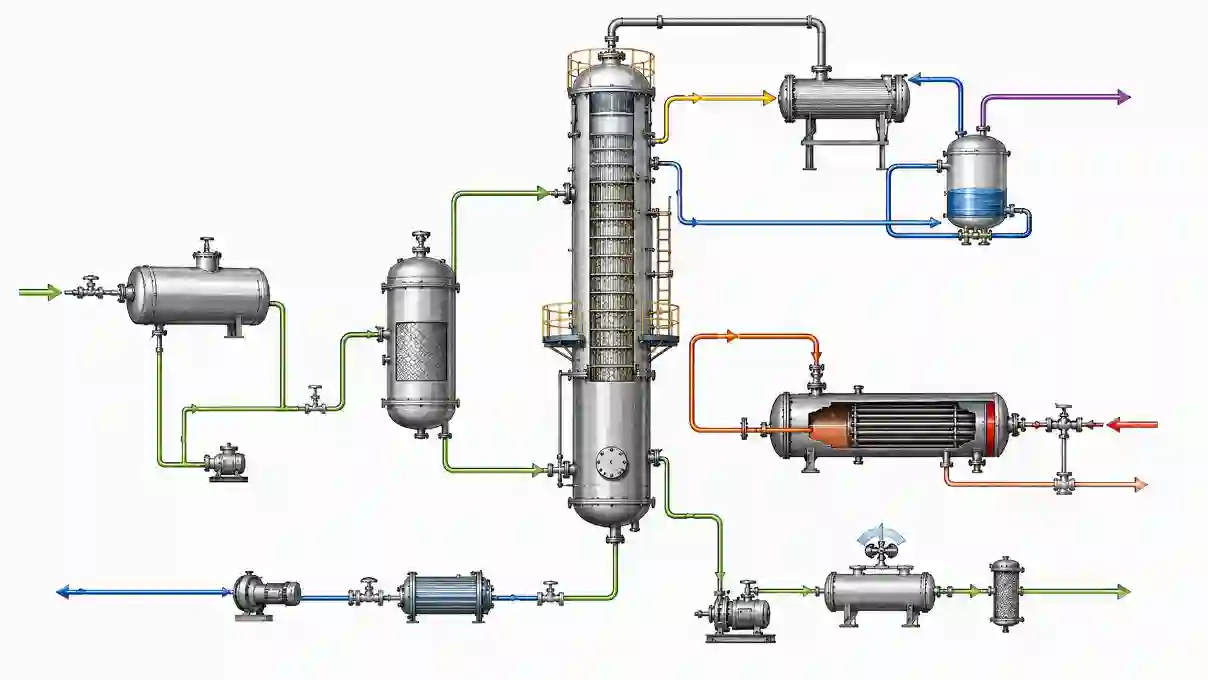
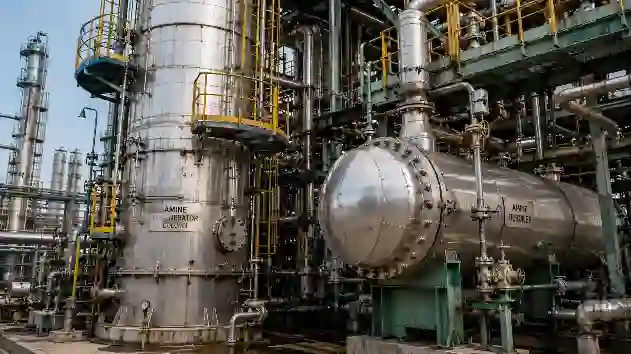
In practice, what inspectors commonly find is that many foaming or carryover issues trace back to poor flash drum performance or inadequate filtration, not the regenerator itself.
Key Equipment Inside an Amine Recovery Unit
Amine Regenerator (Stripper) Column
This is the heart of the ARU — a trayed or packed column operating at low pressure (0.8–1.7 bar). Top temperatures run ~100–110°C, bottoms ~120–130°C. Carbon steel is common but requires careful monitoring for corrosion.
Reboiler
Shell-and-tube exchanger providing heat (typically low-pressure steam). High turbulence and temperature make this a hot spot for amine degradation and corrosion.
Lean/Rich Amine Exchanger
Shell-and-tube or plate type for energy efficiency. Temperature approach is critical for economics.
Rich Amine Flash Drum
Horizontal vessel for hydrocarbon knockout and pressure letdown.
Filters and Carbon Beds
Protect amine quality by removing particulates and organics.
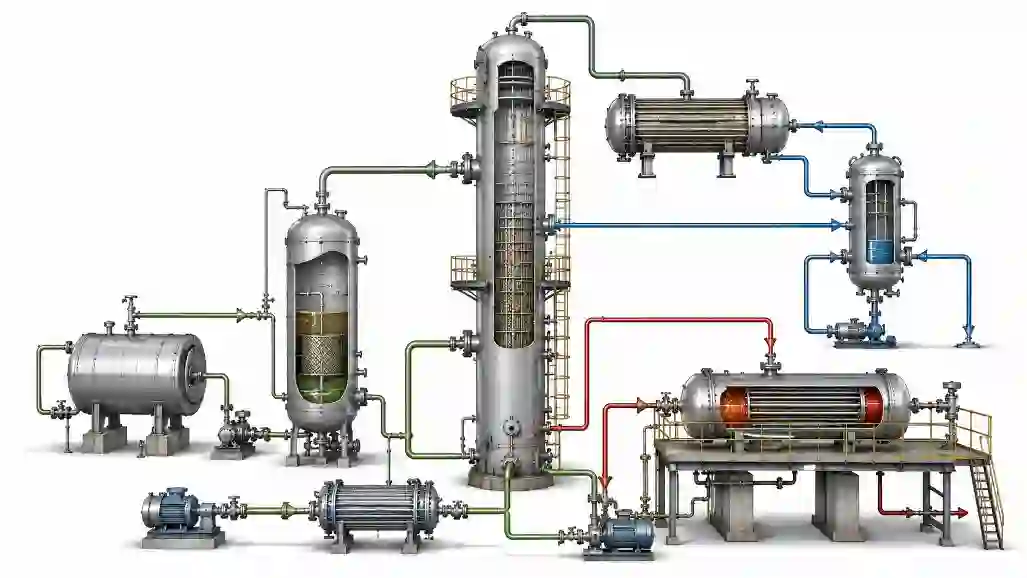
What inspectors commonly find is accelerated thinning or blistering in rich amine lines and regenerator bottoms when acid gas loading exceeds recommended limits (typically 0.3–0.5 mol acid gas/mol amine for MDEA systems).
What Products or Outputs Does an Amine Recovery Unit Produce?
Lean Amine (Regenerated Solvent)
The primary output — cleaned amine solution (typically 25–50 wt% depending on amine type: MEA, DEA, MDEA, etc.) returned to absorbers. Quality directly impacts treating efficiency.
Acid Gas
Concentrated H₂S and CO₂ stream sent to the SRU or, in some cases, acid gas injection. H₂S content often exceeds 80–90% vol after proper regeneration.
Hydrocarbon Flash Gas
Light hydrocarbons from the flash drum, usually routed to fuel gas or recovered.
Condensed Water/Reflux
Returned to the column or treated as sour water.
Summary Table:
| Output | Destination | Typical Composition | Key Spec |
|---|---|---|---|
| Lean Amine | Absorbers | Low H₂S/CO₂ loading | <0.01–0.1 mol/mol |
| Acid Gas | SRU | High H₂S (70-95%) | Minimal hydrocarbons |
| Flash Gas | Fuel Gas System | Light HC + some H₂S | Pressure-dependent |

Common Problems and Inspection Concerns
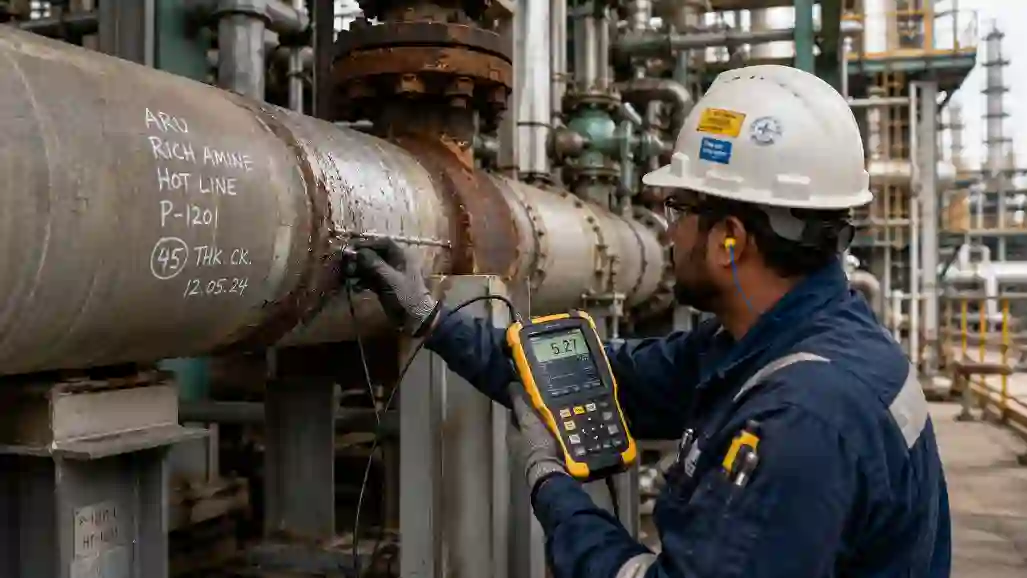
Amine Corrosion and Erosion-Corrosion Caused by high acid gas loading, heat-stable salts (HSAS), and oxygen ingress. Most severe in hot rich amine piping, regenerator bottoms, and reboilers. API 571 covers this extensively. Use UT thickness mapping and IR thermography for monitoring.
Amine Stress Corrosion Cracking (SCC) Occurs in carbon steel exposed to amine, especially MEA and DEA, particularly in non-PWHT’d welds. Reference API RP 945 for mitigation. ACFM or wet fluorescent MPI during turnarounds is effective.
Foaming and Carryover Often due to hydrocarbon contamination or surfactants. What inspectors commonly find is that inlet separators upstream of absorbers are the first line of defense.
Common Misconception: Many believe higher reboiler temperature always improves regeneration. In reality, excessive temperature accelerates thermal degradation of the amine, forming corrosive byproducts.
Practical Insight 1: In humid coastal refineries (like many in India), air ingress through tank vents or pump seals is a silent killer — it oxidizes amines and forms heat-stable salts rapidly.
Practical Insight 2: Always trend lean amine loading with lab analysis. A sudden rise often signals reboiler issues or insufficient steam supply long before product sulfur breaks through.
Practical Insight 3: During turnarounds, I recommend FFS assessment per API 579 on regenerator shells — many older units show significant thinning but remain fit for continued service with proper monitoring.
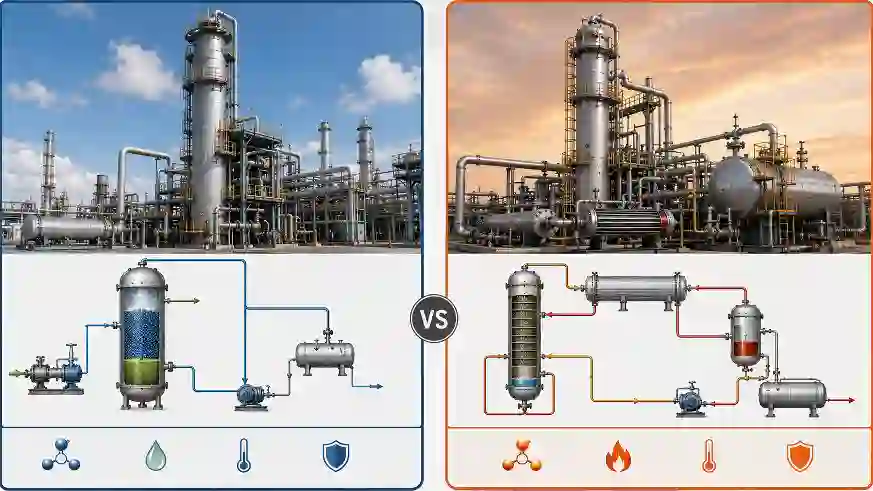
Amine Recovery Unit vs Amine Treating Unit — What Is the Difference?
The amine treating unit usually refers to the full system (absorbers + regeneration), while the amine recovery unit or regeneration unit specifically means the stripper section that regenerates the solvent.
Comparison Table:
| Aspect | Amine Treating (Absorption) | Amine Recovery (Regeneration) |
|---|---|---|
| Primary Function | Acid gas removal from streams | Amine solvent regeneration |
| Operating Pressure | High (5–200+ bar) | Low (near atmospheric) |
| Temperature | 35–50°C | 100–130°C |
| Key Equipment | Absorber columns | Regenerator + reboiler |
| Output | Sweet gas + rich amine | Lean amine + acid gas |
| Corrosion Risk | Lower (cool, rich amine) | Higher (hot, turbulent) |
Conclusion
A well-designed and properly maintained amine recovery unit is the unsung hero of refinery sulfur management. It enables economic recycling of amine, protects downstream units, and ensures compliance with ever-tightening environmental standards. From my field experience, the best-performing ARUs are those where operations, maintenance, and inspection teams work closely — keeping loadings in check, filtration effective, and corrosion under control. Treat your ARU right, and it will keep your refinery sweet and running profitably for decades.
Frequently Asked Questions (FAQs)
What is ARU in oil and gas? ARU stands for Amine Recovery Unit (or Amine Regeneration Unit). It regenerates rich amine by removing absorbed H₂S and CO₂ so the solvent can be reused.
What amine types are commonly used in refinery ARUs? MDEA is popular for selective H₂S removal, while DEA and MEA see use in older units or for bulk CO₂ removal. Blends are also common.
What are typical operating temperatures in an amine regenerator? Regenerator bottoms usually run 120–130°C, with overhead around 100–110°C, depending on amine type and pressure.
How often should amine be analyzed in a refinery? Weekly or bi-weekly for loading, HSAS, and degradation products is standard. More frequent during upsets.
What causes foaming in amine systems? Hydrocarbons, particulates, surfactants, or high flow rates. Proper flash drum design and filtration help prevent it.
Can an ARU handle both H₂S and CO₂? Yes. Most refinery ARUs remove both, though selectivity depends on the amine chosen and operating conditions.
What inspection methods are used on ARU equipment? Visual, UT thickness, RT, ACFM for cracks, IR thermography, and vibration analysis. Follow API 510, 653, and 571 guidelines.
How does amine degradation affect the unit? It forms heat-stable salts that increase corrosion, reduce capacity, and raise viscosity, often requiring reclaiming or purging.
Suggested Posts
What Is a Sulphur Recovery Unit (SRU) in a Refinery?
What Is Alkylation Used For? The Process in Petroleum Refining
Catalytic Reforming Process in Refinery Explained
What Is a Hydrotreating Unit? Process, Working and Purpose Explained
About The Author
