
Introduction
Learn what wet film thickness (WFT) is, how it is measured, how it converts to dry film thickness (DFT), and why the 80/20 DFT rule matters in industrial coating inspection. 2000+ word expert guide.
If you work in painting, pipeline coating, structural steel protection, or industrial tank lining, you have probably heard the term wet film thickness. But what exactly does it mean? How do you measure it? And why does getting it right matter so much?
This complete guide answers all of those questions in plain English. Whether you are a coating inspector, a site painter, or a project engineer, understanding wet film thickness — and how it relates to dry film thickness — is one of the most practical skills you can have on any coating job.
What Is a Wet Film Thickness?
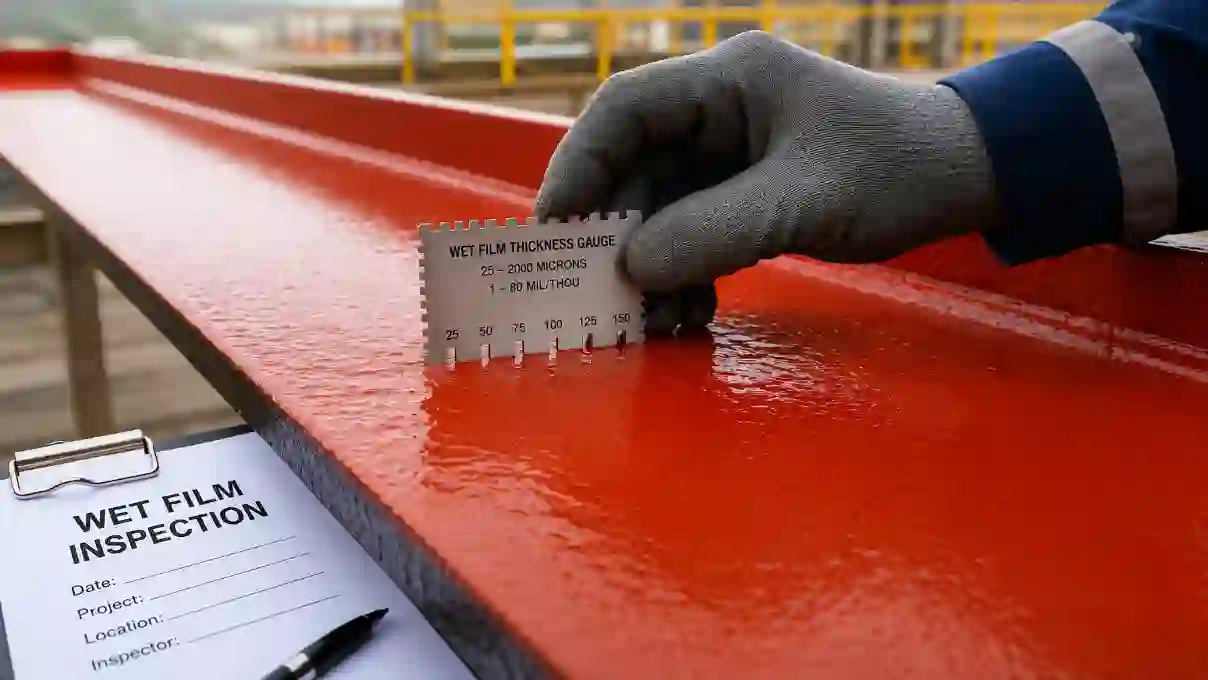
Wet film thickness (WFT) is the measured thickness of a liquid paint or coating immediately after it has been applied to a surface and before it begins to dry or cure.
Think of it like spreading peanut butter on toast. Right after you spread it, you can see — and measure — exactly how thick that layer is. Once it dries out and hardens, it will be thinner. Industrial paint coatings work the same way.
In technical terms, WFT refers to the depth of the liquid film sitting on the substrate at the moment of application. It is measured in microns (µm) or mils, depending on which part of the world you are working in.
Wet film thickness is not just a number — it is a real-time quality control indicator. Measuring WFT during application gives the coating team immediate feedback so they can correct the paint film before it dries and before any rework becomes necessary.
Why Wet Film Thickness Matters in Coating Inspection
Coatings are applied to protect steel, concrete, and other substrates from corrosion, moisture, chemical attack, and weathering. The effectiveness of any coating system depends heavily on achieving the correct dry film thickness (DFT).
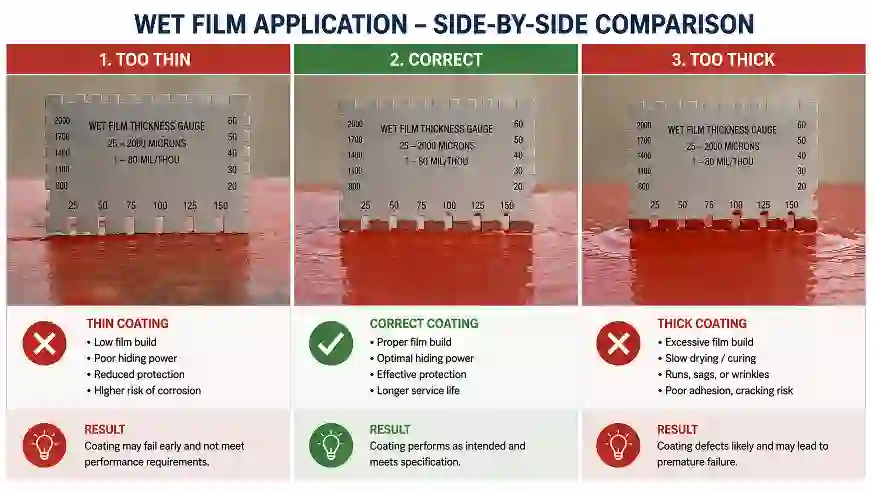
But here is the problem: by the time a coating dries, any application errors are already locked in. If the paint went on too thin, you cannot simply add more on top without re-preparing the surface. If it went on too thick, you may be looking at runs, sags, solvent entrapment, or cracking — all of which lead to early coating failure.
Wet film thickness measurement solves this problem before it becomes expensive.
Reasons WFT Measurement Is Critical:
- It gives applicators real-time control over coating thickness during application
- It prevents under-application, which causes insufficient corrosion protection
- It prevents over-application, which wastes expensive paint material and can cause coating defects
- It helps coating inspectors verify that the specified DFT will be achieved once the coating cures
- It is required by many international coating standards and project specifications
- It significantly reduces the chance of inspection failure and costly rework
In oil and gas, marine, and infrastructure projects, coating failure can cost tens of thousands of dollars in repairs. A simple wet film comb gauge costing a few dollars can prevent all of that.
How Is Wet Film Thickness Measured?
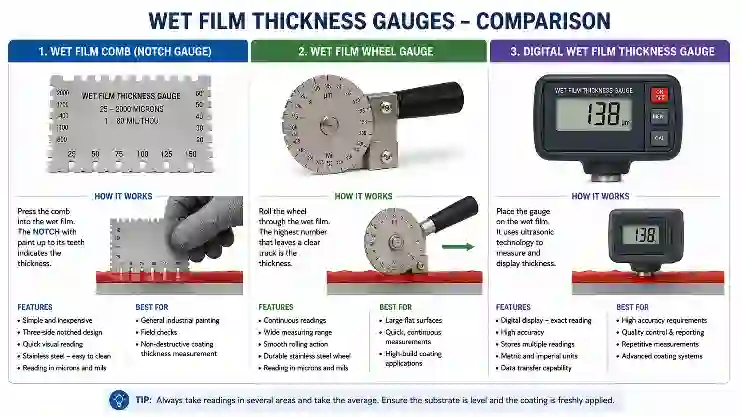
There are three main methods for measuring wet film thickness on site.
1. Wet Film Comb Gauge (Most Common)
The wet film comb gauge — sometimes called a wet film thickness comb or WFT comb — is the most widely used tool in the industry. It is a flat, notched gauge, usually made of stainless steel or plastic, with teeth of varying heights along its edges.
How to use it:
- Immediately after applying the coating, press the comb firmly onto the wet surface at a right angle.
- Lift it straight up without sliding it.
- Look at the teeth. The last tooth that is wet with paint tells you the wet film thickness.
- Record the reading.
The teeth are calibrated to standard increments — for example: 25, 50, 75, 100, 125, 150 microns, and so on. The comb is a one-use check (the paint on the teeth makes it unusable for a second reading in the same spot), so you measure, record, and move on.
2. Wheel Gauge
A wheel gauge rolls across the wet coating surface and uses an eccentric centre wheel to detect thickness. It provides a more continuous reading compared to the comb and is useful on large flat surfaces. It is less common in the field but more suited to production environments.
3. Digital Wet Film Gauge
Some electronic gauges can measure WFT automatically, similar to how digital dry film thickness gauges work. These are used in high-precision industrial applications where manual comb readings are not practical. They are more expensive and less commonly seen on general coating jobs.
For most site inspection work, the comb gauge is the tool of choice. It is cheap, accurate enough for the job, and requires no calibration equipment.
How Wet Film Thickness Converts to Dry Film Thickness
Understanding the relationship between WFT and DFT is at the heart of all coating thickness calculations.
When paint dries, solvents evaporate from the wet film. What remains is the solid content of the paint — the binder, pigments, and other non-volatile components. Because a portion of the paint evaporates, the dry film is always thinner than the wet film.
The Formula:
DFT = WFT × % Volume Solids
The volume solids percentage is published in every paint manufacturer’s data sheet. It tells you what fraction of the wet paint will remain after drying.
Example 1:
- Wet film thickness applied: 250 microns
- Volume solids of the paint: 60%
- DFT = 250 × 0.60 = 150 microns
Example 2:
- Required DFT: 100 microns
- Volume solids: 75%
- Required WFT = 100 ÷ 0.75 = 133 microns
This second calculation is especially useful before painting begins. Once you know the required DFT from the specification and the volume solids from the data sheet, you can calculate the target WFT and brief applicators accordingly.
WFT to DFT Quick Reference Table
| WFT (microns) | Volume Solids 50% | Volume Solids 65% | Volume Solids 80% |
| 100 µm | 50 µm DFT | 65 µm DFT | 80 µm DFT |
| 150 µm | 75 µm DFT | 97.5 µm DFT | 120 µm DFT |
| 200 µm | 100 µm DFT | 130 µm DFT | 160 µm DFT |
| 250 µm | 125 µm DFT | 162.5 µm DFT | 200 µm DFT |
| 300 µm | 150 µm DFT | 195 µm DFT | 240 µm DFT |
Always cross-check the volume solids from the actual paint data sheet for the product you are using. Never assume.
What Is the 80/20 DFT Rule?
The 80/20 DFT rule is one of the most widely referenced acceptance criteria in protective coating inspection. It is referenced in standards such as SSPC PA 2 and many project-specific painting specifications.
What It Means:
- A minimum of 80% of all DFT readings taken in any area must meet or exceed the specified minimum dry film thickness.
- The remaining 20% of readings may fall below the minimum, but only within a defined tolerance — typically not less than 80% of the specified minimum.
Practical Example:
Suppose your specification calls for a minimum DFT of 200 microns.
- At least 80% of your readings must be 200 µm or higher.
- The remaining 20% may be lower, but must not fall below 160 µm (which is 80% of 200).
This rule exists because coating application is never perfectly uniform across a large surface. Spray patterns, surface irregularities, applicator technique, and environmental conditions all contribute to natural variation in film build. The 80/20 rule acknowledges this reality while still setting meaningful quality limits.
Why It Matters for WFT:
When you understand the 80/20 DFT rule, you also understand why measuring WFT throughout application is so valuable. If you are consistently hitting your target WFT, you are much more likely to pass DFT inspection when the coating dries. Monitoring WFT in real time is your best insurance policy against failing DFT readings at the end of the job.
What Is Wet Layer Thickness? Is It the Same as WFT?
Yes. Wet layer thickness and wet film thickness mean exactly the same thing. Both phrases describe the thickness of a coating in its liquid state, immediately after application.
In some industries and regions, you may see one term used more than the other:
- Wet film thickness (WFT) is the standard term used in most international painting standards and inspection documentation.
- Wet layer thickness is sometimes used in continental European specifications and in some academic or technical literature.
If someone on your project uses the term “wet layer thickness,” they are asking for the same measurement and the same tool as wet film thickness.
How Thick Is 3 Wet Mils?
In countries that use imperial measurements — particularly the United States — paint film thickness is often expressed in mils, where one mil equals one-thousandth of an inch (0.001 inch).
3 wet mils = 0.003 inches = approximately 76 microns.
Here is a quick mils-to-microns conversion reference for common coating specifications:
| Wet Mils | Microns (approx.) |
| 1 mil | 25 µm |
| 2 mils | 51 µm |
| 3 mils | 76 µm |
| 4 mils | 102 µm |
| 5 mils | 127 µm |
| 6 mils | 152 µm |
| 8 mils | 203 µm |
| 10 mils | 254 µm |
Most international coating projects use microns. Most US-based specifications still use mils. Make sure you know which unit your project specification is using before you start recording readings.
Common Mistakes When Measuring Wet Film Thickness
Even experienced painters and inspectors make errors when taking WFT readings. Here are the most common ones — and how to avoid them.
Measuring Too Late
WFT must be measured immediately after application. If you wait even a few minutes, solvent evaporation begins and your reading will already be lower than the true applied thickness. On fast-drying paints, you may have only 30–60 seconds to get a valid reading.
Not Measuring Enough Locations
Checking WFT in one spot and assuming it represents the whole surface is a recipe for problems. A good approach is to take readings at multiple locations across each work area — typically at least one reading per 1–5 square meters, depending on the project requirements and the size of the area being painted.
Using a Dirty or Damaged Gauge
A bent tooth on a wet film comb or paint buildup on the gauge will give false readings. Clean your gauge between uses and inspect it regularly for damage.
Not Checking Volume Solids
Measuring WFT is only useful if you compare it to the calculated target WFT. And to calculate the target WFT, you need the correct volume solids from the manufacturer’s data sheet — not a guess, and not a figure from a similar but different product.
Failing to Record Readings
A WFT reading that is not recorded is a WFT reading that never happened in the eyes of a coating inspector. Always document your readings on an inspection report or field record as you go.
Wet Film Thickness in Real Industrial Projects
Across the world’s most demanding coating environments — offshore oil platforms, petrochemical storage tanks, major bridges, ship hulls, and power generation facilities — WFT monitoring is a standard part of the application quality process.
In these environments, coating systems are often multi-coat: a primer, an intermediate coat, and a topcoat. Each coat has its own target WFT, and each must be measured and recorded separately. A failure in any one coat can compromise the entire system.
Coating inspectors certified under programs such as NACE CIP (now AMPP), FROSIO, or ICorr routinely check WFT during application as part of their in-process inspection duties. Project specifications on major infrastructure and industrial jobs almost always require WFT records as part of the quality documentation package.
Best Practices for WFT Measurement on Site

Follow these practical steps to get reliable wet film thickness readings every time:
- Know your target WFT before painting starts. Calculate it from the required DFT and the paint volume solids.
- Measure immediately after application — within 30 to 60 seconds, especially with solvent-based or fast-drying paints.
- Take readings at multiple locations across the work area, not just at one convenient point.
- Use a clean, undamaged wet film comb gauge that is appropriate for the expected thickness range.
- Check and record the volume solids from the product data sheet for each coating being applied.
- Record all readings on a formal inspection report, including location, reading value, time, and ambient conditions.
- Brief the applicators on the target WFT before they begin spraying or brushing, so they can self-monitor their technique.
- Verify ambient conditions — temperature and humidity affect how fast paint dries, which in turn affects how quickly you must take the reading.
WFT vs DFT: Which One Should You Rely On?
The short answer: rely on both, but for different purposes.
WFT is your in-process control tool. It tells you what is happening right now, while you can still make corrections.
DFT is your final acceptance measurement. It tells you whether the finished, cured coating meets specification requirements.
Neither measurement replaces the other. A project that only checks DFT at the end and skips WFT monitoring during application is accepting much higher risk of inspection failures, rework, and coating defects. A project that monitors WFT diligently during application is far more likely to achieve the right DFT outcome — the first time.
Frequently Asked Questions About Wet Film Thickness
What is a wet film thickness?
Wet film thickness is the measured depth of a liquid paint or coating immediately after it is applied to a surface, before it dries or cures.
Why is wet film thickness important?
It allows applicators and inspectors to verify in real time that the coating will achieve the required dry film thickness, preventing under- or over-application before it becomes a problem.
What tool is used to measure wet film thickness?
The most commonly used tool is the wet film comb gauge. Wheel gauges and digital electronic gauges are also used for specific applications.
What is the 80/20 DFT rule?
The 80/20 rule states that at least 80% of dry film thickness readings must meet or exceed the specified minimum value. The remaining 20% may fall below the minimum but must not go below 80% of the specified value.
What is wet layer thickness?
Wet layer thickness is another term for wet film thickness. Both refer to the thickness of a liquid coating immediately after application.
How thick is 3 wet mils?
3 wet mils equals approximately 76 microns.
Is WFT checked before or after drying?
WFT is checked before drying, immediately after the coating is applied while it is still wet.
Can WFT predict DFT?
Yes. Using the formula DFT = WFT × Volume Solids (%), you can predict the expected dry film thickness once you know the paint’s volume solids from the manufacturer’s data sheet.
How many WFT readings should I take?
This depends on the project specification, but a common practice is at least one reading per 1–5 square meters during application. Higher-risk or higher-value projects may require more frequent checking.
What happens if WFT is too low?
If wet film thickness is too low, the coating may dry below the specified minimum DFT, resulting in inadequate corrosion protection and potential early coating failure.
Conclusion
Wet film thickness is one of the simplest yet most powerful quality control measurements in coating inspection. It costs almost nothing to check — a basic wet film comb gauge is inexpensive and fits in your back pocket — yet it gives you immediate, actionable feedback that can prevent coating failures worth thousands of dollars.
To summarise what you need to know:
- WFT is the thickness of paint immediately after application, before drying.
- It is most commonly measured with a wet film comb gauge.
- DFT = WFT × % Volume Solids is the key formula to know.
- The 80/20 DFT rule governs final coating acceptance on most industrial projects.
- Wet layer thickness and wet film thickness are the same thing.
- 3 wet mils equals approximately 76 microns.
- Always measure immediately after application and record your readings.
Master wet film thickness measurement and you will have a solid foundation for producing coating work that passes inspection, lasts longer, and protects the structures that depend on it.
Suggested Posts
Epoxy Coating Failure: Causes, Defects, Blistering and Prevention
Coating Blistering: Causes, Prevention & Role of Chloride Contamination
Best Industrial Coatings for Corrosion Protection: 11 Types Explained
Painting Inspection Standards (ISO, ASTM, SSPC, NACE) – Complete Guide for QA/QC Engineers
About The Author
