
Spray Painting Introduction: What You Really See on Site
On most industrial sites, Spray Painting looks simple from a distance.
A painter holds a spray gun, moves it across the surface, and within minutes, a large area is coated. Fast, clean, and efficient.
But step closer, and you’ll notice something important:
👉 Not every spray-painted surface is the same.
Some finishes are smooth and uniform. Others show rough texture, uneven thickness, or overspray. The difference is not the paint—it’s how Spray Painting is done.
This is where understanding Spray Painting systems becomes critical for:
- Coating inspectors
- Engineers
- Painting contractors
Because in reality, application method controls coating performance.
Spray Painting Basics: How Spray Painting Actually Works
Understanding the Spray Painting Process
Spray Painting is a method where liquid paint is converted into a fine mist and applied onto a surface using a spray gun.
This process is called atomization.
Instead of applying paint as a liquid layer (like brushing), Spray Painting breaks it into tiny droplets, allowing:
- Better surface coverage
- Faster application
- More uniform coating
Why Atomization Matters in Spray Painting
On site, poor atomization is easy to spot:
- Rough finish (orange peel)
- Patchy coating
- Excess paint loss
Good atomization gives:
- Smooth finish
- Even thickness
- Better adhesion
👉 In simple terms:
If atomization is wrong, the coating will never perform as expected.
Spray Painting Methods: Choosing the Right System for the Job
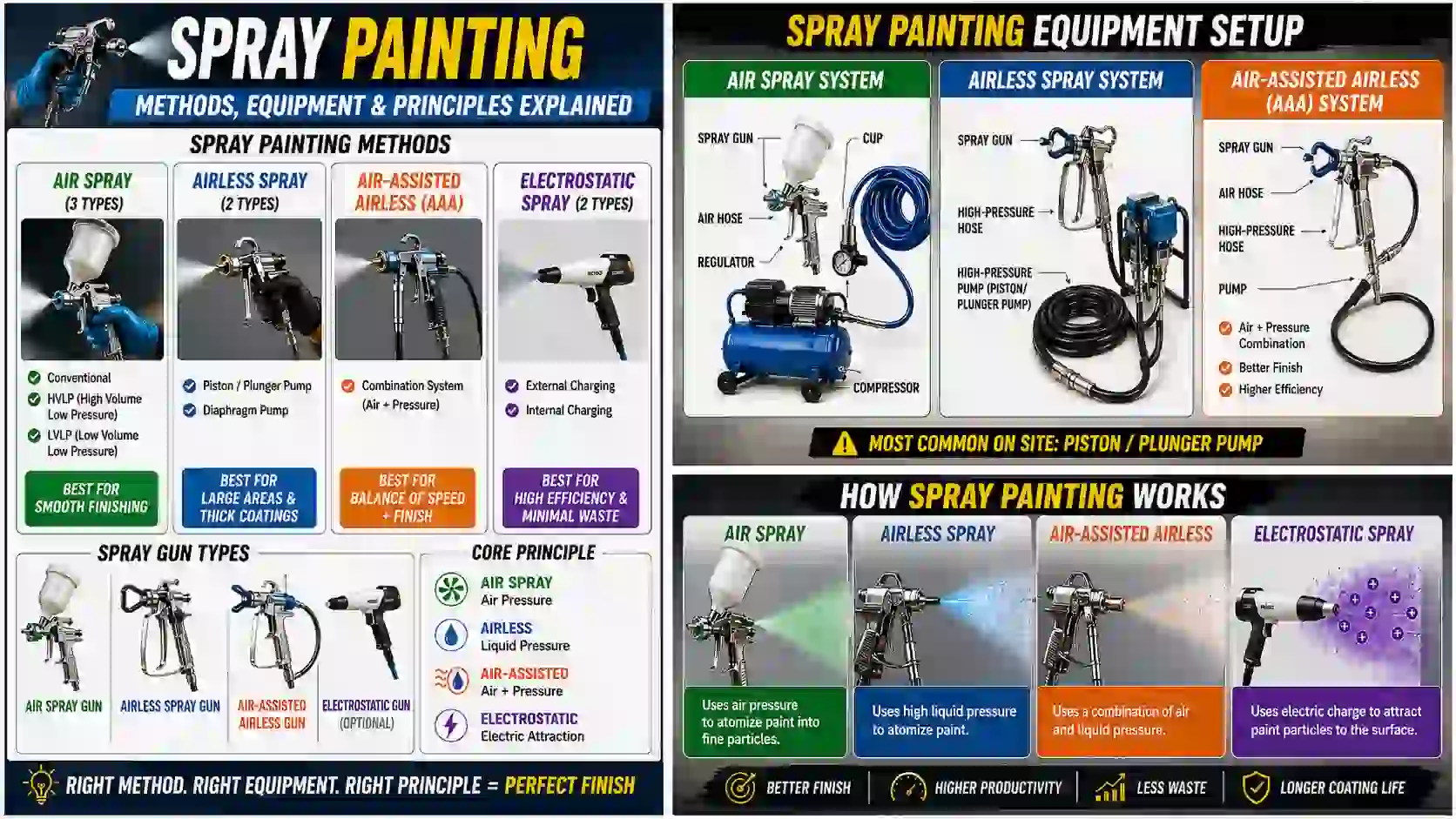
Different jobs require different Spray Painting methods. Using the wrong one is a common mistake on site.
Air Spray Methods in Spray Painting (Conventional, HVLP, LVLP)
Where Air Spray Is Used
Air spray is mostly used where finish quality matters more than speed.
Common applications:
- Decorative coatings
- Automotive work
- Thin film coatings
How Air Spray Works
Air is used to break the paint into fine particles.
This gives:
- Excellent control
- Smooth and high-quality finish
Limitations of Air Spray
- High overspray
- More paint wastage
- Slower compared to other methods
Airless Spray Painting Methods (Piston Pump and Diaphragm Pump)
Where Airless Spray Is Used
If you visit any industrial site, this is what you’ll see most often.
Airless Spray Painting is used for:
- Large pipelines
- Storage tanks
- Structural steel
👉 Most common equipment: Piston (Plunger) Pump
How Airless Spray Works
Instead of air, high pressure forces the paint through a small tip, creating atomization.
Why Airless Spray Is Preferred on Site
- Very fast application
- Handles thick coatings easily
- Covers large areas quickly
What to Watch Out For
- Finish is not as smooth as air spray
- Requires proper pressure control
- Risk of uneven thickness if handled poorly
Air-Assisted Airless Spray Painting (AAA System)
Why This System Is Used
This method combines:
- Speed of airless
- Finish quality of air spray
Where It Works Best
- Medium to high-quality coating jobs
- When both finish and productivity matter
What Makes It Different
A small amount of air is added to improve spray pattern, giving better control than pure airless systems.
Electrostatic Spray Painting System
Where Electrostatic Spray Is Used
You’ll usually see this in controlled environments like:
- Manufacturing plants
- Factory coating lines
How Electrostatic Spray Works
Paint particles are electrically charged and attracted to the surface.
Why It Is Highly Efficient
- Very high transfer efficiency
- Minimal paint loss
- Uniform coating even on complex shapes
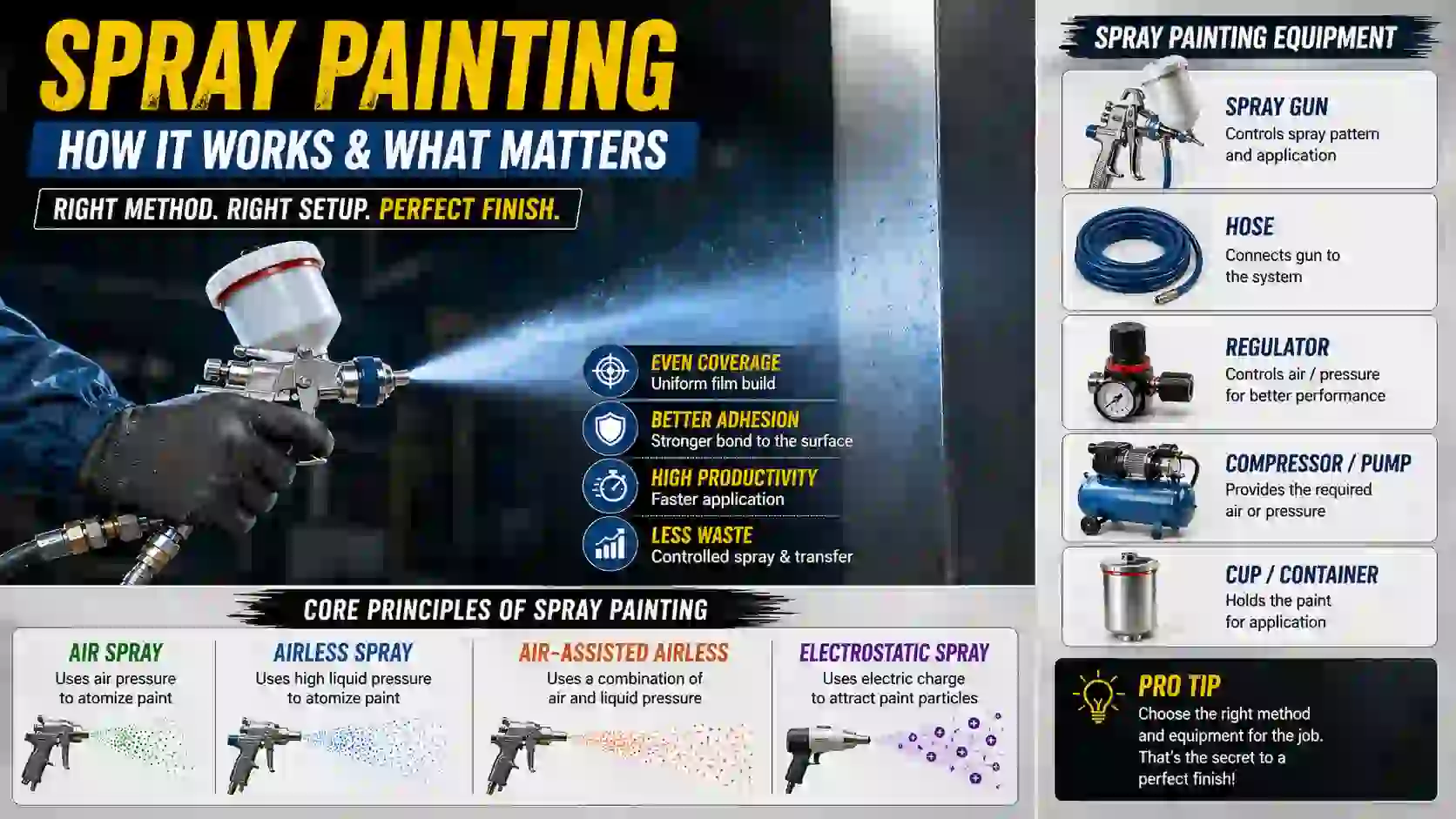
Spray Painting Equipment: What You Actually Use on Site
Air Spray Equipment Setup
Typical setup includes:
- Spray gun
- Paint cup
- Air hose
- Pressure regulator
- Compressor
Airless Spray Equipment Setup
On most sites, the setup is simpler but more powerful:
- Spray gun
- High-pressure hose
- Pump
👉 Most commonly used: Piston / Plunger pump
Spray Painting Gun Types: Choosing the Right Tool
Different Spray Painting guns are designed for different applications.
Air Spray Gun
Best for fine finishing and detailed work.
Airless Spray Gun
Used for heavy coatings and large areas.
Air-Assisted Airless Gun
Balances speed and finish.
Electrostatic Spray Gun
Used in specialized, high-efficiency applications.
Spray Painting Principles: What Drives Each System
Understanding the principle behind each system helps in troubleshooting and inspection.
Air Spray Principle
Uses air pressure for atomization.
Airless Principle
Uses liquid pressure.
Air-Assisted Principle
Uses air + pressure combination.
Electrostatic Principle
Uses electrical attraction.
Spray Painting Mistakes: What Commonly Goes Wrong on Site
Even experienced teams make these mistakes:
Choosing the Wrong Method
Using air spray where airless is required (or vice versa).
Poor Equipment Setup
Incorrect pressure settings lead to poor atomization.
Ignoring Surface Preparation
No coating system will perform on a poorly prepared surface.
Incorrect Spray Technique
Wrong distance or angle causes uneven coating.
Spray Painting Importance: Why This Knowledge Matters
For inspectors and engineers, Spray Painting is not just application—it’s quality control.
Understanding it helps you:
- Identify coating defects early
- Improve coating performance
- Reduce rework and cost
Conclusion: What You Should Take Away
Spray Painting may look simple, but it is a highly controlled process.
The final coating quality depends on:
- The method used
- The equipment setup
- The skill of application
When done correctly, Spray Painting delivers:
👉 Better finish
👉 Longer coating life
👉 Higher efficiency
And on site, that makes all the difference.
Spray Painting FAQs: Practical Questions from Site
What is Spray Painting in simple terms?
It is a method of applying paint as a fine mist using a spray gun.
What is atomization in Spray Painting?
It is the process of breaking paint into tiny particles for uniform application.
Which method gives the best finish?
Air spray (especially HVLP) gives the smoothest finish.
Where is Airless Spray Painting used?
It is used for large areas and thick coatings in industrial projects.
What is the advantage of electrostatic Spray Painting?
It improves efficiency and reduces paint wastage.
Which pump is most common on site?
Piston (plunger) pumps are widely used.
Why does Spray Painting fail sometimes?
Due to poor setup, wrong method, or bad surface preparation.
Is Spray Painting better than brushing?
For large and uniform coating, yes—it is faster and more efficient.
Suggested Posts
Pipeline Coating Inspection: Why Field Joint Coating Fails First (FBE Guide)
Airless Spray Painting: Simple Guide for Better Coating Quality
3 LPE vs 3LPP Coating System – Complete Guide for Pipeline Coating
Painting Inspection Standards (ISO, ASTM, SSPC, NACE) – Complete Guide for QA/QC Engineers
About The Author

Pls send me spay pating video
Please check on Youtube, you know very well most of the projects dont allow to click photos and videos.