
The Dolly Test (Pull-Off Adhesion Test) is one of the most important methods used to measure coating adhesion strength on metal surfaces. It is widely used in coating inspection, painting QA/QC, and steel fabrication to ensure that protective coatings are properly bonded to the substrate.
This test plays a critical role in industries like oil & gas, pipelines, offshore structures, and construction, where coating failure can lead to serious corrosion problems.
What is Dolly Test (Pull-Off Adhesion Test)?
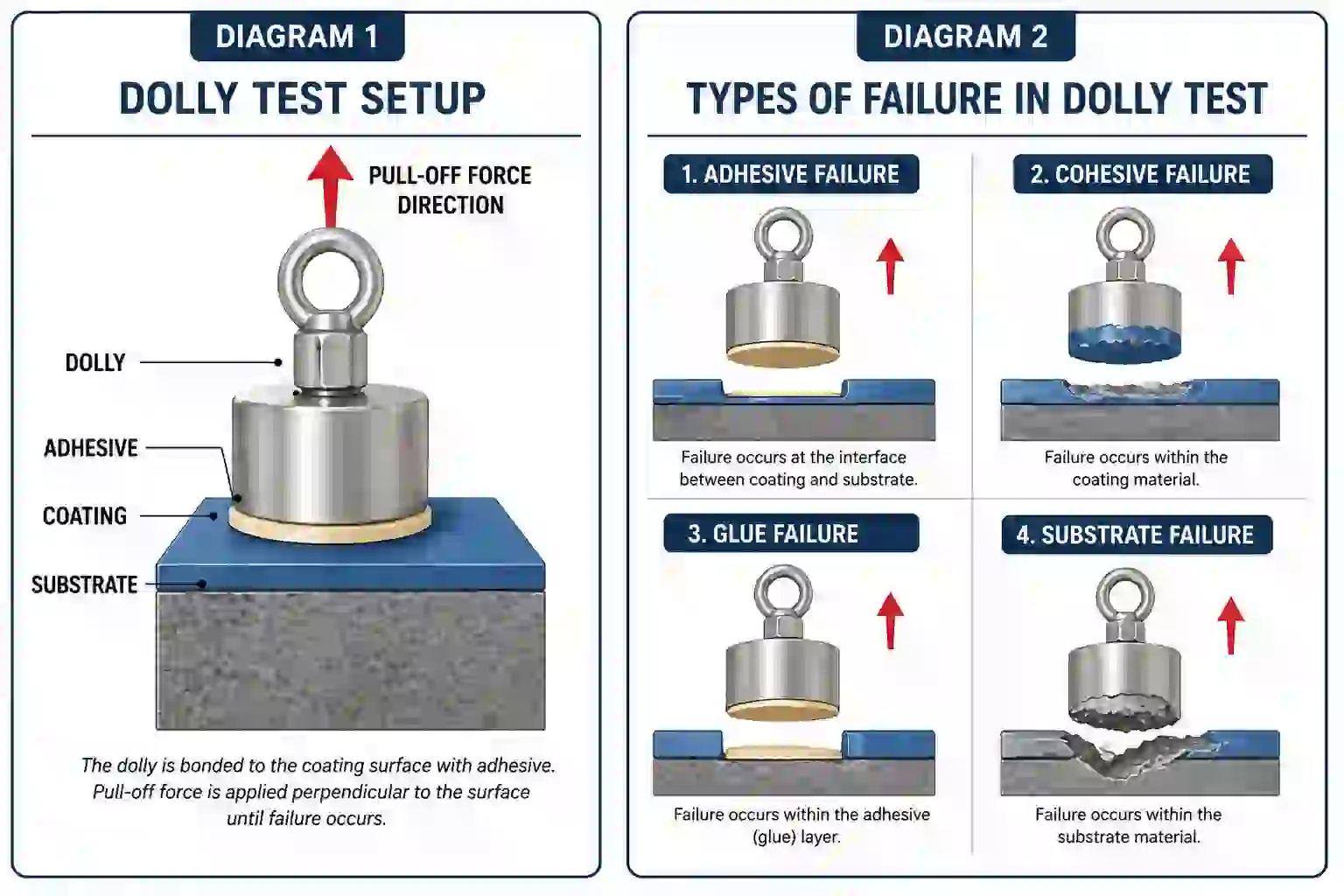
The Dolly Test is used to measure how strongly a coating is attached to a surface. In this method, a metal piece called a dolly is glued to the coating, and force is applied perpendicular (90°) until the coating fails.
The result is measured in:
- MPa (Megapascal)
- psi (pounds per square inch)
This value represents the adhesion strength of the coating.
Principle of Pull-Off Adhesion Test
The test works on a simple principle:
A metal dolly is bonded to the coated surface using a strong adhesive. A pull-off tester then applies tensile force until the coating detaches. The maximum force required is recorded as adhesion strength.
Why Dolly Test is Important in Coating Inspection
The Pull-Off Adhesion Test is very important because it helps:
- Ensure coating reliability
- Prevent early coating failure
- Improve corrosion protection
- Avoid costly repairs and rework
- Maintain quality standards in projects
In critical structures like offshore platforms, poor coating adhesion can quickly lead to corrosion and structural damage.
Dolly Test Equipment and Tools
The following equipment is required:
- Pull-off adhesion tester (manual or hydraulic)
- Dollies (usually 20 mm diameter, aluminium or steel)
- Epoxy adhesive (high strength)
- Dolly cutter (for isolating test area)
- Cleaning tools (solvent, cloth)
- Digital gauge (attached to tester)
Surface Preparation Before Adhesion Test
Proper surface preparation is very important for accurate results.
- Ensure coating is fully cured
- Clean surface (remove dust, oil, moisture)
- Light surface abrasion if required
- Mark test location
Dolly Test Procedure Step by Step
First, clean and prepare the surface. Apply adhesive to the dolly and fix it firmly on the coating surface. Allow proper curing time (dwell time). If required, use a dolly cutter to isolate the test area.
After curing, attach the pull-off tester and apply load gradually. Record the pressure at which failure occurs. Finally, inspect the failure mode.
Dolly Test Dwell Time (Very Important)
Dwell time is the curing time required for adhesive.
Typical values:
- 24 hours at 25°C (standard epoxy)
- 4–6 hours (fast curing adhesive)
Factors affecting dwell time:
- Temperature
- Humidity
- Adhesive type
Incorrect dwell time can lead to wrong test results.
Dolly Test Standards
The most commonly used standards are:
- ASTM D4541
- ISO 4624
- SSPC-PA 2
Always follow project specifications and client requirements.
Dolly Test Acceptance Criteria
Acceptance values depend on coating type and project requirements.
| Coating Type | Minimum Adhesion Value |
| Industrial Coating | ≥ 3 MPa |
| Heavy Duty Coating | ≥ 5 MPa |
| Offshore Structures | ≥ 7 MPa |
Always refer to project specification for final acceptance.
Types of Failure in Dolly Test
Understanding failure mode is very important in QA/QC.
Adhesive Failure
Occurs between coating and substrate. This indicates poor bonding and is not acceptable.
Cohesive Failure
Occurs within the coating layer. This is sometimes acceptable depending on specification.
Glue Failure
Occurs between dolly and adhesive. This is an invalid test and must be repeated.
Substrate Failure
Occurs when the base metal fails. This shows excellent adhesion.
Applications of Pull-Off Adhesion Test
The Dolly Test is widely used for:
- Coating adhesion verification
- Steel fabrication inspection
- Pipeline coating inspection
- Offshore structure inspection
- PEB structures
- Post-repair inspection
- Failure analysis
Common Mistakes in Dolly Test
Some common mistakes include:
- Using expired adhesive
- Not allowing proper curing time
- Testing near edges or welds
- Poor surface cleaning
- Incorrect test procedure
Avoiding these ensures accurate results.
Real-World Example
In offshore environments, coatings are exposed to saltwater. If adhesion is weak, corrosion starts quickly. A proper Dolly Test ensures that coating strength is sufficient before the structure is put into service.
Conclusion
The Dolly Test (Pull-Off Adhesion Test) is a critical inspection method used to measure coating adhesion strength. Proper procedure, correct dwell time, and understanding failure modes are essential for accurate results.
This test helps ensure coating performance, prevents corrosion, and increases the life of steel structures.
FAQs – Dolly Test (Pull-Off Adhesion Test)
What is acceptable adhesion strength in Dolly Test?
It depends on coating type, but generally 3 MPa to 7 MPa is acceptable.
What causes failure in pull-off adhesion test?
Poor surface preparation, incorrect curing, or weak coating bonding.
What is dwell time in dolly test?
It is the curing time required for adhesive before testing.
Which standard is used for adhesion testing?
ASTM D4541 and ISO 4624 are commonly used.
Is glue failure a valid result?
No, glue failure means the test is invalid.
Suggested Posts
Knife Adhesion Test: Understanding ASTM D6677
Types of Corrosion: Causes, Mechanisms and How to Prevent Them
3 LPE vs 3LPP Coating System – Complete Guide for Pipeline Coating
About The Author
