
Introduction
If you are searching for clear and practical Welding QC notes, you’re in the right place. This guide explains everything in a simple way—from ASME welding codes and AWS electrode classification to welding processes, defects, and material standards.
Welding Quality Control (QC) is not just theory—it’s what ensures that pipelines don’t leak, pressure vessels don’t fail, and structures remain safe for years. Industries like oil & gas, fabrication, and power plants depend heavily on proper QC practices.
In simple terms, QA/QC is the backbone of any welding job. Without it, even a small mistake can lead to major failures. That’s why understanding codes, materials, and procedures is so important.
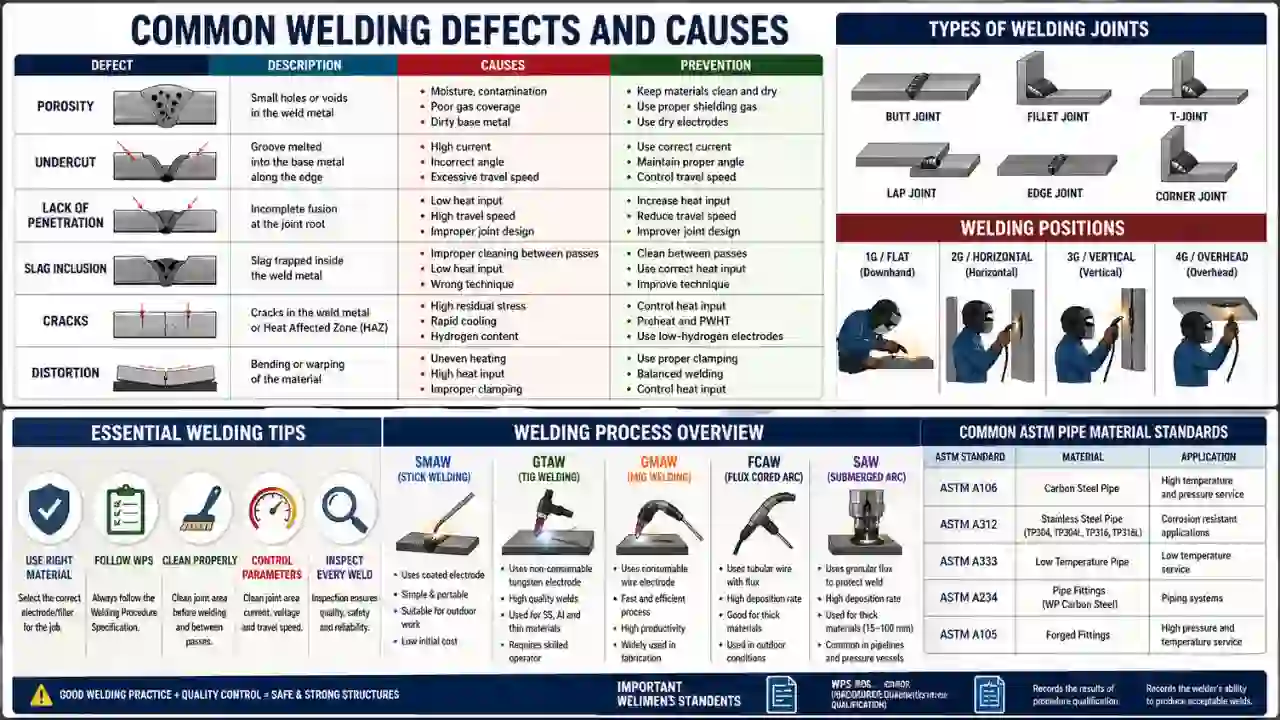
1. Understanding ASME BPVC (Simple Explanation)
The ASME Boiler and Pressure Vessel Code (BPVC) is one of the most important standards used worldwide. It provides rules for designing, manufacturing, and inspecting boilers and pressure vessels.
Main ASME Sections You Should Know
- Section I – Power Boilers
- Section II – Materials
- Part A: Ferrous materials
- Part B: Non-ferrous materials
- Part C: Welding consumables
- Part D: Mechanical properties
- Section III – Nuclear components
- Section IV – Heating boilers
- Section V – Non-Destructive Testing (NDT)
- Section VIII – Pressure vessels
- Division 1: Up to 3000 psi
- Division 2: 3000–10000 psi
- Division 3: Above 10000 psi
- Section IX – Welding & brazing qualifications
- Section XII – Transport tanks
👉 In short: ASME tells you what to do and how to do it safely.
2. Piping Codes and Material Standards
Before welding starts, selecting the right material is very important. A wrong material choice can lead to failure, no matter how good the welding is.
Common ASME Piping Codes
- B31.1 – Power piping
- B31.3 – Process piping (refineries, chemical plants)
- B31.4 – Liquid pipelines
- B31.8 – Gas pipelines
Common ASTM Materials Used
- Carbon Steel Pipes: A53, A106, A333 (low temperature)
- Stainless Steel Pipes: A312 (TP304, TP316, etc.)
- Fittings: A234, A403
- Valves/Forgings: A105, A216
👉 Simple idea:
ASME = rules
ASTM = material quality
3. Welding Documents: WPS, PQR, and WQT
In welding QC, documentation is everything. Without proper records, the weld is not considered reliable.
Three Important Documents
- WPS (Welding Procedure Specification): This is like a recipe. It tells you how to weld—material, current, voltage, and technique.
- PQR (Procedure Qualification Record): This proves that the WPS actually works. A test weld is done and tested.
- WQT (Welder Qualification Test): This checks whether the welder has the skill to follow the WPS properly.
👉 In simple words:
WPS = Instructions | PQR = Proof | WQT = Skill check
4. AWS Electrode Classification (Easy Breakdown)
Choosing the right electrode is very important. AWS classification helps you understand what each electrode does.
Example: E7018
- E = Electrode
- 70 = Tensile strength (70,000 psi)
- 1 = All welding positions
- 8 = Coating type (low hydrogen, DCEP)
Common AWS Specifications
- SFA-5.1 – Carbon steel electrodes (SMAW)
- SFA-5.18 – Filler wires (GMAW/GTAW)
- SFA-5.20 – Flux-cored electrodes
👉 Once you understand this coding, selecting electrodes becomes much easier.
5. Welding Processes (Simple Overview)
Different jobs need different welding methods. Here are the most commonly used ones:
SMAW (Stick Welding)
Uses coated electrodes. It is simple, widely used, and suitable for outdoor work.
GTAW (TIG Welding)
Produces very clean and high-quality welds. It uses a tungsten electrode and is best for stainless steel and thin materials.
GMAW (MIG Welding)
A fast and efficient process that uses continuous wire. It is commonly used in fabrication shops.
SAW (Submerged Arc Welding)
Used for thick materials with high production speed. Mostly applied in heavy industries.
6. Components: Flanges, Valves, and Gaskets
A piping system is made of more than just pipes. Connections are equally important.
Flange Types
Weld Neck, Slip-On, Socket Weld, Blind, and Lap Joint
Valve Types
Gate valve, Globe valve, Ball valve, Butterfly valve, and Check valve (NRV)
Gasket Types
Full Face, Spiral Wound, and Ring Type Joint (RTJ)
👉 These components ensure leak-proof and safe connections.
7. Welding Defects and Causes
One of the main jobs of a QC inspector is to identify defects and prevent them.
Common Welding Defects
- Porosity – Gas trapped inside the weld
- Undercut – Groove formed along the weld edge
- Slag Inclusion – Slag trapped in weld metal
- Lack of Penetration – Weld does not reach the root
- Cracks – Most dangerous defect
- Spatter & Arc Strikes – Surface defects
👉 Most defects happen due to wrong settings, poor cleaning, and incorrect technique.
Conclusion
Welding QC is not just about checking welds—it’s about ensuring safety, reliability, and long-term performance.
By understanding ASME codes, AWS classification, WPS documents, and material standards, you can confidently handle welding inspection and quality control tasks.
Whether you are a student, welder, or QC inspector, these basics will help you build a strong foundation in welding technology.
Frequently Asked Questions (Welding QC)
1. What are Welding QC notes? Welding QC notes are simple guidelines that help ensure weld quality, safety, and compliance with standards.
2. What is ASME in welding? ASME provides rules for designing, welding, and inspecting pressure vessels and piping systems.
3. What is AWS electrode classification? It is a system that explains electrode properties like strength, position, and coating.
4. What is WPS in welding? WPS is a document that tells how to perform a weld correctly.
5. What are common welding defects? Porosity, undercut, slag inclusion, lack of penetration, and cracks.
6. Which ASTM standards are used in piping? A106, A312, and A333 are commonly used pipe material standards.
Suggested Posts
Welding Interview Questions: Top 50 Questions and Answers for Freshers & Experienced
Painting Inspection Standards (ISO, ASTM, SSPC, NACE) – Complete Guide for QA/QC Engineers
What is a Non Conformance Report? – When to Issue an NCR?
Industrial Surface Protection: Protecting Materials for Long-Term Use
About The Author
