
Introduction
Trade Test Questions and Answers: Abrasive blasting is one of the most important stages in a protective coating system. If the steel surface is not prepared correctly, even a high-quality coating system can fail prematurely. For this reason, a blaster’s skill has a direct effect on the quality, durability and performance of the final coating.
For a new blaster joining an oil and gas, fabrication, maintenance or industrial painting project, a practical blaster trade test is an important way of checking whether the person has the knowledge and practical ability required for the job.
This article provides 25 Blaster Trade Test Questions and Answers that can be used by QC Engineers, coating inspectors, supervisors and blasting supervisors when assessing a new blaster. The questions cover the basic technical knowledge a blaster should understand before being allowed to perform abrasive blasting independently.
The purpose of this 25 Blaster Trade Test Questions and Answers guide is not to test whether a blaster can memorize complicated technical definitions. A good trade test should determine whether the blaster understands what he is doing, why he is doing it, and how his blasting technique affects the final steel surface.
The actual blasting parameters should always be taken from the approved project specification, coating manufacturer’s technical data sheet, method statement and ITP. Values such as blasting pressure, nozzle size, abrasive type, surface profile and surface preparation grade are not universal values and should not be assumed to be the same for every project.
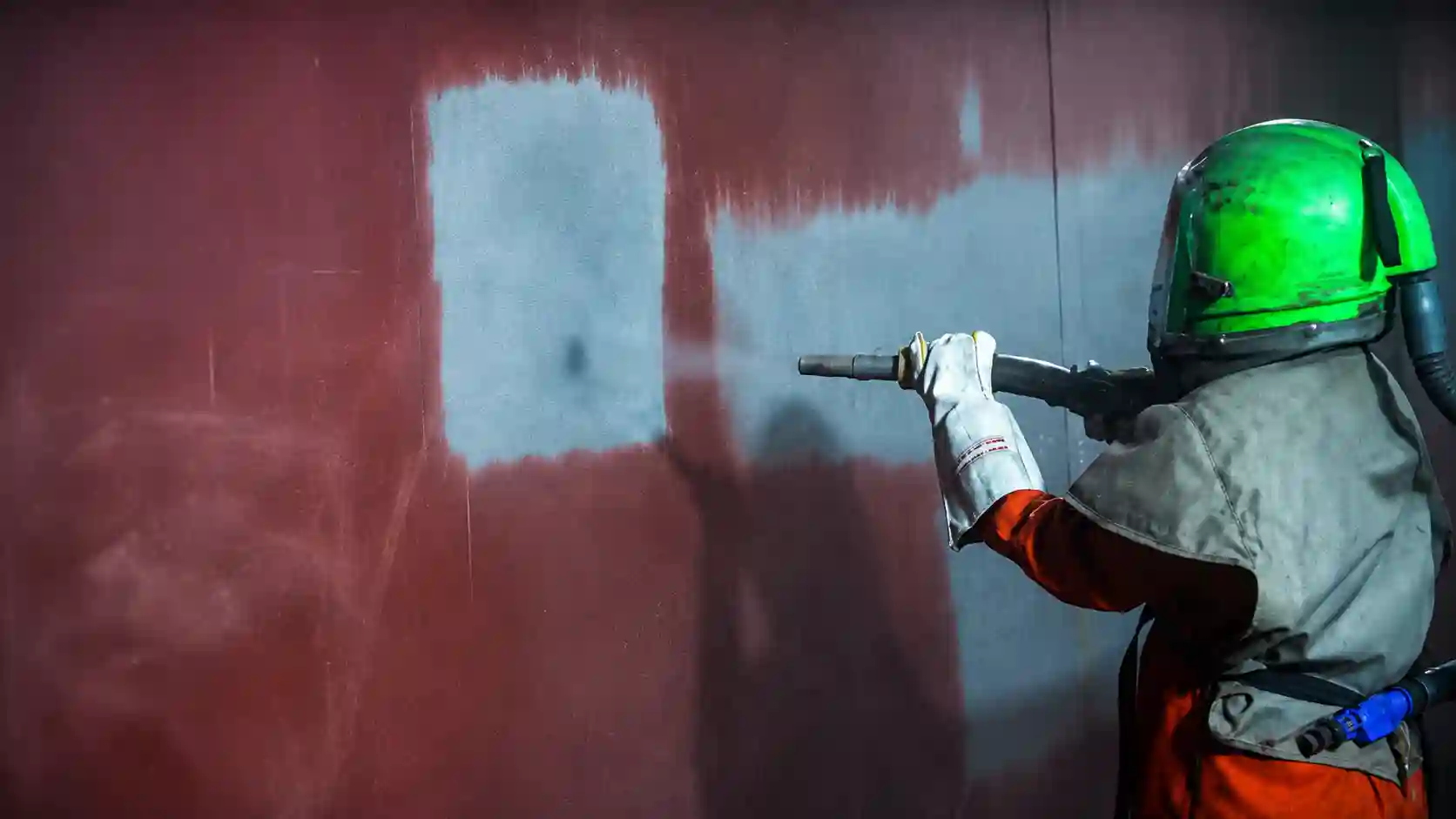
Why Is a Blaster Trade Test Important?
A blaster may have several years of experience and still have poor blasting technique. Experience alone does not guarantee that the required surface preparation will be achieved.
During a trade test, the QC Engineer should check two things:
- Does the blaster understand abrasive blasting?
- Can the blaster produce the required surface in practice?
For example, a blaster may know that Sa 2½ is required, but if he holds the nozzle too far away, moves it too quickly or uses incorrect blasting parameters, the final surface may not meet the required standard.
Similarly, a blaster may know that a 75–100 µm surface profile is required, but that does not mean he can consistently produce that profile.
Therefore, the best qualification process combines a verbal/theoretical test with a practical blasting test.
25 Blaster Trade Test Questions and Answers
Below are 25 questions that can be used during a blaster qualification or trade test.
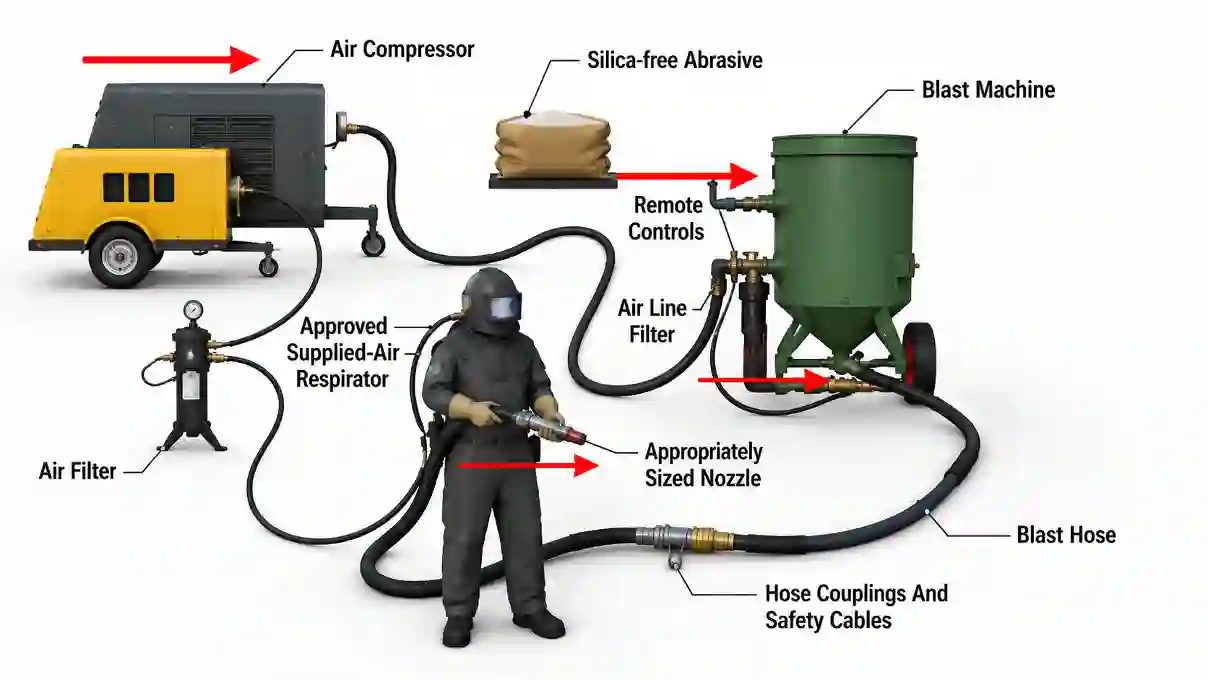
1. What is the purpose of abrasive blasting?
Answer:
The main purpose of abrasive blasting is to remove rust, mill scale, old coating, dirt and other contaminants from the steel surface and to produce the required surface cleanliness and surface profile for proper coating adhesion.
The blaster should understand that blasting is not simply about making the steel look clean. The surface also needs to have the correct profile for the coating system being applied.
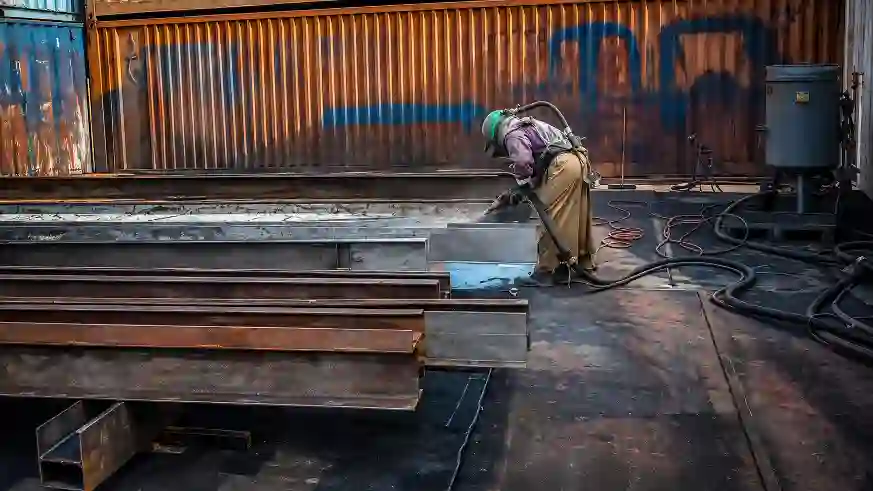
2. What surface preparation grade is required for this job?
Answer:
The required surface preparation grade depends on the approved project specification, coating system and method statement.
For example, if the requirement is Sa 2½, the steel surface must be blast cleaned to Sa 2½ in accordance with the applicable standard.
The blaster should know the required grade before starting the job rather than assuming that every blasting activity requires the same level of preparation.
For example, depending on the specification, a project may require Sa 2, Sa 2½ or Sa 3.
QC point: The correct answer should always be checked against the approved project documents.
3. What abrasive are you using?
Answer:
The blaster should know the type and grade of abrasive being used for the job.
For example, the abrasive may be garnet 30/60, depending on the approved blasting procedure.
The abrasive must be suitable for the blasting equipment, coating system and required surface profile and must comply with the applicable project requirements.
A blaster should never simply start blasting with an unknown abrasive.
4. What is the required abrasive cleanliness or conductivity?
Answer:
The abrasive must meet the cleanliness and soluble salt/conductivity requirements specified for the project.
For example, where the applicable project specification requires abrasive conductivity to be within a specified limit, the abrasive must be tested and confirmed to comply before use.
For one commonly encountered requirement, the conductivity of the abrasive extraction solution may be limited to 150 µS/cm. However, the exact requirement must be taken from the applicable project specification.
The reason this is important is that contaminated abrasive can introduce salts or other contaminants onto the steel surface.
5. What nozzle size do you normally use?
Answer:
The nozzle size depends on the blasting equipment, compressor capacity, abrasive and project requirements.
A ½-inch nozzle is commonly used for many blasting applications, but the blaster should use the nozzle size specified or approved for the particular job.
The blaster should also understand that changing the nozzle size can affect air consumption, blasting performance and the pressure available at the nozzle.
6. What blasting pressure do you normally use?
Answer:
The required blasting pressure depends on the nozzle, abrasive, equipment and project requirements.
The important point is that the blaster should know the required pressure at the nozzle, rather than assuming that the pressure shown at the compressor is the same pressure reaching the nozzle.
For example, a procedure may specify approximately 90–100 psi at the nozzle, but the actual value must be taken from the approved procedure for the job.
A good blaster should understand that pressure, nozzle size, distance, angle and travel speed all work together.
7. What is the correct nozzle distance from the steel?
Answer:
A commonly used working distance is approximately 100–120 mm (4–5 inches) from the steel surface, depending on the nozzle, pressure, abrasive and application.
The most important point is to maintain a consistent working distance.
If the blaster continually changes the distance, the blasting impact will change and the resulting surface cleanliness and profile may become inconsistent.
The exact distance should always follow the approved blasting procedure.
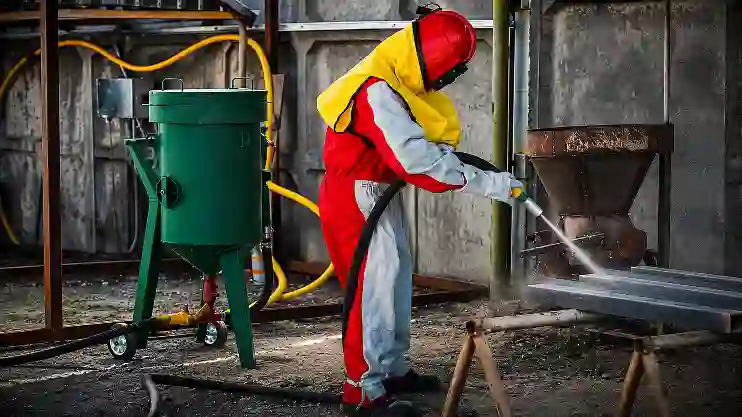
8. What is the correct blasting angle?
Answer:
For many steel blasting applications, the nozzle is generally held at approximately 75° to 90° to the surface, depending on the application and approved procedure.
At 90°, the nozzle is perpendicular or straight toward the surface.
At 75°, the nozzle is slightly inclined from perpendicular.
The blaster should avoid using an unnecessarily shallow angle because the blasting impact and cleaning effectiveness can be affected.
The important point is that the angle should be controlled consistently together with the nozzle distance and travel speed.
9. How do you control the blasting speed?
Answer:
The blaster controls the blasting speed by continuously moving the nozzle across the surface at a controlled and consistent rate.
If the nozzle moves too quickly, the abrasive may not remain on the surface long enough to remove the contamination properly.
If the nozzle moves too slowly, the surface may receive excessive blasting and unnecessary abrasive impact.
The correct travel speed depends on the condition of the steel and the required surface preparation.
A skilled blaster learns to adjust his movement while maintaining a consistent blasting pattern.
10. What happens if you move the nozzle too far from the surface?
Answer:
If the nozzle is too far away, the blasting impact on the steel is reduced.
This can result in:
- Lower cleaning efficiency
- Incomplete removal of rust or coating
- Difficulty achieving the required surface profile
- Increased abrasive wastage
The blaster should therefore maintain the specified working distance as consistently as possible.
11. What happens if you keep the nozzle too close?
Answer:
If the nozzle is held too close, the abrasive impact becomes more concentrated and aggressive.
Depending on the material and blasting parameters, this can result in excessive surface profile, unnecessary surface damage, increased abrasive consumption and excessive rebound.
The blaster should not assume that holding the nozzle closer will always produce a better result.
The correct combination of distance, pressure, angle and movement speed is what produces the required surface.
12. How do you achieve the required surface profile?
Answer:
The required surface profile is achieved by controlling several blasting parameters together.
These include:
- Abrasive type and size
- Nozzle size
- Blasting pressure
- Nozzle distance
- Blasting angle
- Travel speed
- Condition of the steel
For example, if the specified surface profile is 75–100 µm, the blaster must use the correct blasting parameters to produce that profile.
The profile should then be measured using the appropriate surface profile measurement method.
A blaster should understand that surface profile is not controlled by pressure alone.
13. How do you know when blasting is complete?
Answer:
The blaster should visually inspect the surface and compare it with the required surface preparation grade.
The surface should be uniformly prepared, with unacceptable rust, mill scale, old coating and other contaminants removed according to the specified grade.
The blaster should also look carefully for missed areas, edges, corners, weld areas, behind structural members and other difficult-to-reach locations.
Where required, the QC Inspector will verify the surface preparation before painting.
14. What do you do if you see oil, grease or other contamination?
Answer:
The blaster should not simply blast over oil or grease.
The affected area should be stopped, reported and cleaned using the approved cleaning method before blasting continues.
Blasting contaminated areas can spread the contamination over the surface rather than properly removing it.
This is especially important because oil, grease and other contaminants can seriously affect coating adhesion.
15. What do you do if the blasted surface starts showing flash rust?
Answer:
The blaster should inform the supervisor or QC Engineer and stop or control the work as required.
The affected surface must be assessed against the applicable specification. If the flash rust is beyond the allowable level, the surface may need to be reblasted or otherwise treated according to the approved procedure.
The blaster should never assume that any level of flash rust is acceptable.
The important point is to identify the condition and report it before coating is applied.
Additional Blaster Trade Test Questions
The following additional questions are useful because they test whether the blaster understands the practical side of achieving a consistent blasted surface.
16. Why is the condition and size of the abrasive important?
Answer:
The abrasive has a direct effect on the cleaning performance and surface profile.
Different abrasive sizes and types produce different blasting results. A suitable abrasive should be selected according to the approved procedure and required profile.
If the abrasive is too fine, it may not produce the required profile efficiently. If it is too coarse or unsuitable, it can produce an excessive or inconsistent profile.
The abrasive must also be clean and free from unacceptable contamination.
17. What happens if the blasting nozzle becomes worn?
Answer:
A worn nozzle can increase the nozzle opening and change the blasting performance.
This can increase air consumption and reduce the effective blasting pressure at the nozzle. The blasting pattern and productivity can also be affected.
The nozzle should therefore be inspected regularly and replaced when it reaches the manufacturer’s or project-approved wear limit.
A blaster should not continue using a badly worn nozzle simply because abrasive is still coming out.
18. Why is it important to keep the nozzle moving?
Answer:
Keeping the nozzle moving helps produce a more uniform surface.
If the nozzle remains in one location for too long, that area can receive excessive abrasive impact and develop a deeper or uneven profile.
Continuous controlled movement also helps the blaster achieve a consistent surface preparation over the entire area.
19. Should the blaster concentrate only on flat surfaces?
Answer:
No.
The blaster must pay attention to all areas that require surface preparation, including:
- Edges
- Corners
- Weld areas
- Around supports
- Flanges
- Difficult-to-reach areas
- Areas behind structural members
- Small or restricted sections
These locations are often missed because they are more difficult to blast.
A good blaster should inspect the complete surface rather than concentrating only on large, easily accessible areas.
20. What is the effect of incorrect blasting pressure?
Answer:
If the pressure is too low, the blasting may not remove contamination effectively or achieve the required profile.
If the pressure is too high, it may result in excessive abrasive consumption and potentially excessive surface profile or damage, depending on the substrate and blasting parameters.
Therefore, the blaster should work within the pressure range specified by the approved procedure.
21. Why is overlapping the blasting passes important?
Answer:
Overlapping the blasting passes helps produce uniform surface preparation and prevents strips or missed areas between passes.
The blaster should use a controlled pattern and overlap adjacent passes sufficiently to achieve complete and uniform coverage.
A poor blasting pattern can leave visible unblasted lines or patches.
22. How can you recognize an area that has not been blasted properly?
Answer:
The area may show remaining rust, mill scale, old coating, discoloration or a different surface appearance compared with the properly blasted surrounding steel.
The blaster should look for differences in surface appearance and should pay particular attention to edges, corners, welds and difficult areas.
If an area does not meet the specified preparation grade, it needs further preparation before it is accepted.
23. Why should the surface profile be checked after blasting?
Answer:
The surface profile provides the required mechanical key for the coating.
If the profile is too low, the coating may not obtain the required adhesion characteristics.
If the profile is excessive, the coating may not adequately cover the surface peaks and valleys, and additional coating may be required to achieve the specified DFT.
Therefore, the profile must be within the range specified for the coating system.
The QC Engineer or coating inspector should verify the profile using the approved measurement method.
24. What should you do if the required surface profile is not being achieved?
Answer:
The blaster should not simply continue blasting without identifying the reason.
He should inform the supervisor or QC Engineer and check the blasting parameters, such as:
- Abrasive type and size
- Abrasive condition
- Nozzle size
- Nozzle condition
- Blasting pressure
- Nozzle distance
- Blasting angle
- Travel speed
The parameter causing the problem should be corrected and the surface should be rechecked.
The blaster should understand that more blasting is not always the solution.
25. Why is consistent blasting technique important?
Answer:
Consistent blasting technique produces a more uniform surface preparation and surface profile.
The blaster should maintain consistent:
- Nozzle distance
- Nozzle angle
- Travel speed
- Blasting pressure
- Blasting pattern
- Overlap between passes
A skilled blaster does not continuously change these parameters without a reason.
Consistency is one of the most important qualities to look for during a blaster trade test.
How Should a QC Engineer Conduct the Blaster Trade Test?
The 25 Blaster Trade Test Questions and Answers above can be used as the theoretical portion of the qualification. However, a QC Engineer should not qualify a blaster based only on his verbal answers.
A proper trade test should have a practical component.
Step 1 – Check the Project Requirements
Before conducting the test, review the applicable:
- Approved Method Statement
- Inspection and Test Plan
- Coating specification
- Project specification
- Paint manufacturer’s requirements
- Applicable surface preparation standard
- Approved abrasive requirements
This is important because the correct blasting parameters can change from one project to another.
For example, one job may require Sa 2½ and a 75–100 µm profile, while another coating system may have different requirements.
Step 2 – Conduct the Verbal Test
Ask the blaster the questions without giving him the answers beforehand.
You do not necessarily need to expect the exact wording provided in this article. Instead, determine whether he understands the basic principle behind each question.
For example, if you ask:
“What happens if the nozzle is too far from the surface?”
A good answer would be something like:
“The impact will reduce, cleaning will become poor and I may not achieve the required profile.”
The answer does not need to be complicated.
Step 3 – Conduct the Practical Blasting Test
After the verbal assessment, provide a designated test panel or approved test area.
Give the blaster the parameters applicable to your project, such as:
- Abrasive type
- Nozzle size
- Required pressure
- Required surface preparation grade
- Required surface profile
- Applicable blasting distance
- Applicable blasting angle
Then observe his technique.
Pay particular attention to whether he can maintain approximately 100–120 mm (4–5 inches) where that is the specified working distance and whether he can maintain the required nozzle angle consistently.
What Should the QC Engineer Observe During Practical Blasting?
A practical trade test should not be judged only by how quickly the blaster finishes.
Observe whether the blaster:
- Maintains a consistent nozzle distance
- Maintains the required angle
- Keeps the nozzle moving
- Uses a controlled travel speed
- Produces an even blasting pattern
- Covers the complete surface
- Gives attention to edges and corners
- Does not unnecessarily overblast one location
- Produces the required visual cleanliness
- Produces the required surface profile
After the blasting is completed, inspect the surface carefully.
Surface Cleanliness and Profile Verification
This is where the QC Engineer’s role becomes particularly important.
A surface can look good to the naked eye and still fail the technical requirement.
The blasted surface should be checked for the specified surface preparation grade using the applicable visual standard.
The surface profile should then be measured using the approved profile measurement method.
For example, if the coating specification requires a profile of 75–100 µm, the QC Engineer should verify that the measured profile complies with that requirement.
Do not assume that a blaster has achieved the correct profile simply because the steel has a rough appearance.
Common Mistakes Made by New Blasters
During a trade test, several common problems can be identified.
Holding the nozzle too far away
The blaster may stand too far from the steel because it feels more comfortable. However, excessive distance reduces blasting effectiveness.
Holding the nozzle too close
Some inexperienced blasters believe that getting closer automatically improves blasting. It can instead produce excessive impact and an uneven profile.
Moving too quickly
The blaster may try to complete the area quickly. This can leave rust, mill scale or old coating behind.
Moving too slowly
This can result in excessive blasting of certain areas and an inconsistent profile.
Ignoring difficult areas
Edges, welds, corners and areas around supports are commonly missed.
Focusing only on appearance
A surface may look clean but still have an incorrect surface profile.
Continuing without checking the parameters
If the profile is not correct, the answer is not always to continue blasting. The abrasive, nozzle, pressure, distance, angle and travel speed should all be considered.
Suggested Pass Criteria for a Blaster Trade Test
The exact pass criteria should be established by your company and project requirements.
A useful evaluation can include:
| Assessment | Suggested Weight |
|---|---|
| Technical knowledge | 25% |
| Blasting technique | 25% |
| Surface cleanliness | 20% |
| Surface profile | 20% |
| Overall workmanship | 10% |
| Total | 100% |
For example, your company may establish an 80% pass mark, but this should be based on your approved qualification procedure rather than treated as a universal industry requirement.
A blaster who achieves a good theoretical score but cannot produce the required surface during the practical test should not automatically be considered qualified.
Important Parameters a Blaster Should Understand
The following parameters work together during abrasive blasting:
Abrasive + Pressure + Nozzle Size + Distance + Angle + Travel Speed = Final Surface Condition
Changing one parameter can affect the final result.
For example, increasing pressure does not automatically mean better blasting. If the nozzle is too far away or the blaster moves too quickly, the expected result may still not be achieved.
Likewise, holding the nozzle at 90° does not guarantee the correct surface profile. The abrasive, pressure, nozzle condition, distance and travel speed also matter.
This is why a practical trade test is so valuable.
8 Frequently Asked Questions About Blaster Trade Tests
How many questions should be asked during a blaster trade test?
There is no single universal number. A company may use a different number depending on its qualification procedure. A set of 25 Blaster Trade Test Questions and Answers provides a good practical question bank covering the important technical areas.
The questions should be supported by a practical blasting test.
Is previous blasting experience enough to qualify a new blaster?
No. Previous experience is useful, but it should not replace qualification.
The blaster should demonstrate that he understands the current project’s requirements and can produce the required surface under actual working conditions.
What is the most important part of the blaster trade test?
The practical blasting test is one of the most important parts.
The blaster should demonstrate that he can maintain the required nozzle distance, angle, pressure and travel speed and can produce the required surface cleanliness and profile.
Is 90° always the best blasting angle?
Not necessarily.
For many steel blasting applications, a nozzle angle in the approximate 75°–90° range may be used, but the exact requirement depends on the approved blasting procedure and application.
At 90°, the nozzle is perpendicular to the surface. At 75°, it is slightly inclined.
The correct angle should be selected together with the required distance, pressure and blasting technique.
Is 100–120 mm the correct distance for every blasting job?
No.
Approximately 100–120 mm (4–5 inches) is a commonly used working distance for some blasting applications, but it should not be treated as a universal rule.
The approved project procedure, equipment, nozzle, abrasive and application should determine the correct distance.
Can the blaster achieve the correct profile just by increasing pressure?
No.
Surface profile depends on several factors, including abrasive type and size, nozzle size, pressure, nozzle distance, angle, travel speed and steel condition.
Increasing pressure alone is not a reliable way to control profile.
Should the QC Engineer measure the surface profile after the blaster completes the test?
Yes, where surface profile measurement is required by the applicable specification.
The QC Engineer should verify the result using the approved measurement method and confirm that the measured profile is within the specified range.
Can a blaster pass the trade test if he answers all the questions correctly but fails the practical test?
Normally, he should not be considered fully qualified if the practical requirement is not achieved.
The purpose of the trade test is to demonstrate both knowledge and practical ability.
A person may know the correct answers but still be unable to control the nozzle and produce the required surface.
Conclusion
A blaster trade test should be more than a simple interview. The purpose is to establish that a new blaster understands the fundamentals of abrasive blasting and can apply those principles correctly in the field.
These 25 Blaster Trade Test Questions and Answers provide a practical starting point for QC Engineers who need to evaluate new blasting personnel.
The most important areas to assess are the blaster’s understanding of surface preparation, abrasive selection, blasting pressure, nozzle size, nozzle distance, blasting angle, travel speed and surface profile. The blaster should also understand what happens when these parameters are not properly controlled.
For example, a typical blasting setup may involve a 100–120 mm working distance and approximately 75°–90° nozzle angle, but these values should always be confirmed against the approved project procedure rather than treated as universal requirements.
Most importantly, the theoretical test should be followed by a practical test. Observe the blaster while he works, inspect the blasted surface, verify the required surface preparation grade and measure the surface profile where applicable.
A good blaster is not simply someone who can remove rust quickly. A good blaster is someone who can consistently produce the specified surface condition while controlling the blasting parameters correctly.
For a QC Engineer, that is the real purpose of a blaster trade test: to verify that the person has the knowledge, technique and workmanship necessary to produce a surface that is ready for the next stage of the coating system.
Use these 25 Blaster Trade Test Questions and Answers as a practical assessment guide, but always give priority to your approved project specification, method statement, ITP, coating manufacturer’s requirements and applicable standards.
Suggested Posts
Paint Viscosity Cup: Procedure, Importance, Standards, and Effect on DFT & WFT
What Is an Isomerization Unit? How Refineries Increase Gasoline Octane
Why Is It Called a Delayed Coker? Process Explained
What Is a Hydrotreating Unit? Process, Working and Purpose Explained
About The Author
